

Some dogs and cats curl up together on the sofa. Others can’t be in the same room without someone losing a cushion or an eyebrow. The difference usually comes down to breed tendencies, individual temperament, and whether the introduction was handled well or badly.
Breed isn’t everything, a calm, well-socialised terrier can outperform a poorly introduced Golden Retriever. But if you’re choosing a dog to join a cat household, starting with the right breed stacks the odds heavily in your favour.
Key Takeaways
- Low prey drive is the single most important trait for cat compatibility
- Golden Retrievers, Cavalier King Charles Spaniels, and Basset Hounds are consistently among the most cat-friendly breeds
- Sight hounds and terriers bred for hunting need careful assessment, their chase instinct is strong
- Individual temperament matters more than breed stereotypes, always meet the specific dog
- Puppies under four months adapt most easily, but adult dogs with known temperaments offer predictability
- Proper introductions take 2-4 weeks minimum, rushing creates problems that last months
The Most Cat-Friendly Dog Breeds
Golden Retriever
The default recommendation for good reason. Goldens have gentle mouths, cooperative temperaments, and moderate prey drive that’s typically directed at fetching rather than chasing small animals. They read body language well and usually learn to respect a cat’s “back off” signals quickly. Their main risk is size, a 30kg Golden playing enthusiastically can accidentally knock a cat sideways.
Cavalier King Charles Spaniel
Bred purely for companionship, Cavaliers tend to approach cats with curiosity rather than chase instinct. They’re small enough not to intimidate most cats and gentle enough to share a sofa without incident. Their main drawback: they can be needy, which occasionally annoys cats who prefer personal space.
Labrador Retriever
Similar to Goldens in temperament, sociable, trainable, and generally happy to accept cats as part of the household. Labs can be bouncier than Goldens when young, which may stress nervous cats, but they settle into reliable housemates. Their food obsession sometimes extends to cat food bowls, so separate feeding stations are essential.
Basset Hound
The quintessential laid-back breed. Bassets are scent-focused rather than sight-focused, so a running cat triggers far less chase response than in other hounds. Their low energy suits cats who don’t appreciate being pestered. They may occasionally howl, which cats generally find less threatening than being chased.
Maltese and Bichon Frise
Toy and companion breeds with minimal prey drive. Their small size means cats are rarely intimidated, and both breeds are intelligent enough to learn household boundaries quickly. The Maltese in particular tends to be placid around other animals. The Bichon’s playful nature can occasionally irritate a grumpy cat, but rarely escalates beyond a warning swat.
Pug
Pugs want to be near people, not chase animals. Their low energy, compact size, and comedically unbothered temperament make them surprisingly good cat companions. They’re robust enough to handle an occasional cat swipe without injury, and too lazy to chase anything for more than a few steps.
Breeds to Approach With Caution
Sight Hounds (Greyhounds, Whippets, Lurchers)
Their entire breed history is built on chasing fast-moving small things. Some retired Greyhounds are cat-tested by rescue organisations and live safely with cats, but this must be assessed individually. Never assume a sight hound is cat-safe without specific testing, the instinct is deeply hardwired.
Terriers (Jack Russell, Border, Patterdale)
Terriers bred for ratting or hunting have strong prey drives directed at small, fast-moving animals. Individual variation is huge, some Jack Russells are fine with cats, others absolutely aren’t. If you’re set on a terrier, choose one raised with cats from puppyhood, or look for rescues that specifically cat-test their dogs.
Herding Breeds (Border Collies, Australian Shepherds)
The issue isn’t aggression, it’s the herding instinct. Border Collies may stalk, circle, and nip at cats, which is stressful for the cat even without causing injury. Their intense focus and high energy can overwhelm cats who prefer a calm household. Some individuals are fine, but the breed tendency needs active management.
Introducing a Dog to Your Cat
The First Week
Keep the new dog and your cat completely separate for at least 48-72 hours. Let them investigate each other’s scent under doors and through barriers. Set up separate feeding stations, water bowls, and sleeping areas, resource competition causes unnecessary stress even between compatible animals.
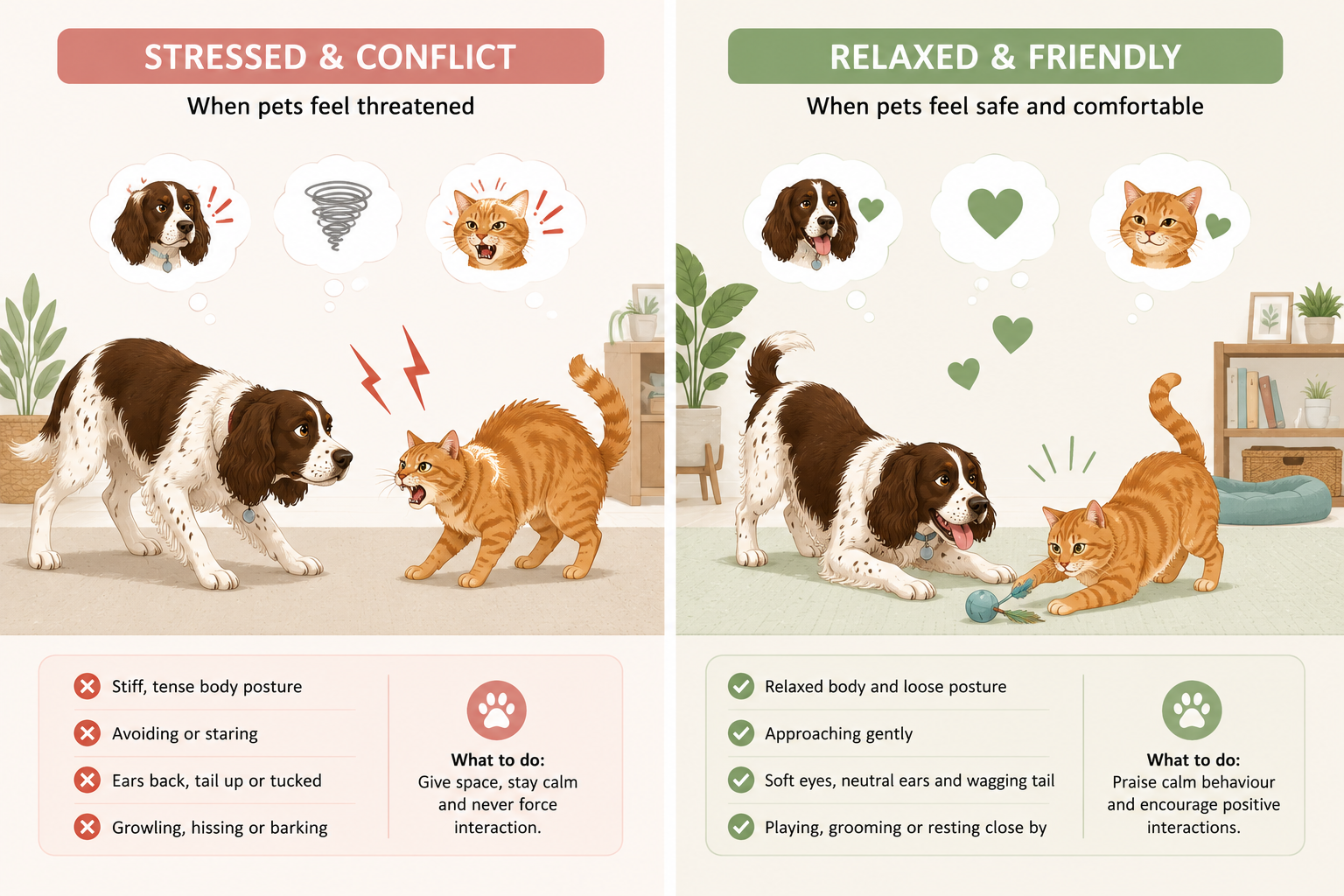
Before the dog arrives, create vertical escape routes: shelves, cat trees, and baby gates your cat can jump over but the dog can’t. Cats need to observe from a safe height, not feel cornered on the floor.
Controlled Introductions
Progress to brief visual contact through a barrier, a baby gate works well. Watch for stress signals: panting, pacing, or fixated staring from the dog; hiding, hissing, or flattened ears from the cat. Keep sessions short and positive. If either animal is stressed, go back a step.
Gradually increase contact time over 2-4 weeks, always supervised. Some pairs bond quickly, others need months. Rushing the process almost always creates setbacks that take longer to fix than doing it slowly in the first place.
When It’s Not Working
Contact a certified animal behaviourist if introductions aren’t progressing after 2-3 weeks, or if either animal shows chronic stress: over-grooming, litter box problems, destructive behaviour, or persistent hiding, the same signs of stress cats show in catteries.
Seek immediate help if there’s any aggressive incident, chasing, cornering, growling, or physical contact. Early intervention prevents these behaviours from becoming established. Your vet can also assess whether anti-anxiety medication might help during the adjustment period.
Not every pairing works. If a behaviourist concludes the animals can’t safely coexist, that’s a legitimate outcome, not a failure. Some dogs’ prey drive is simply too strong, and some cats’ stress response never settles. Knowing when to rehome or permanently separate is part of responsible ownership.
Frequently Asked Questions
Can any dog learn to live with cats?
Most dogs can learn to coexist peacefully, but not all. Dogs with extremely high prey drive may never be trustworthy alone with cats, regardless of training. A professional assessment helps set realistic expectations for your specific dog.
How long does a successful introduction take?
Initial introductions typically take 2-4 weeks, but full integration can require 2-3 months. Some pairs click within days, others need gradual progress over much longer. Rushing almost always backfires.
Are puppies or adult dogs better with cats?
Puppies under four months adapt most easily because their chase instincts haven’t fully developed, and adult cats can teach them boundaries early. Adult dogs offer more predictable temperaments but need longer adjustment periods. If you’re bringing home a puppy, our new puppy guide covers the other essentials for the first few weeks.
Are rescue dogs with unknown histories suitable?
Many rescue dogs integrate successfully with cats, but unknown histories require careful evaluation. Foster-to-adopt arrangements let you assess compatibility before committing. Reputable rescues often cat-test their dogs and can advise on individual temperaments.
What if my cat is very territorial?
Territorial cats need extra time, space, and patience. Create multiple distinct territories using baby gates and vertical spaces. Synthetic pheromone diffusers can help reduce stress. Some territorial cats never fully bond with dogs but learn to coexist in separate zones, that’s a reasonable outcome.