
Choosing between a cattery and a cat sitter isn't about finding the "best" option, it's about matching the right care to your cat's personality. Some cats thrive with professional cattery supervision, while others are happiest staying home with visiting care.
Key Takeaways
- Environment matters most: Anxious cats generally prefer familiar surroundings; confident cats may adapt well to catteries
- Licensing: Catteries must be licensed under the 2018 Regulations in England (Wales similar, Scotland inconsistent). Cat sitters in your home generally don't need one.
- Cost crossover: Cat sitting is often cheaper for short breaks; catteries become more economical for longer holidays
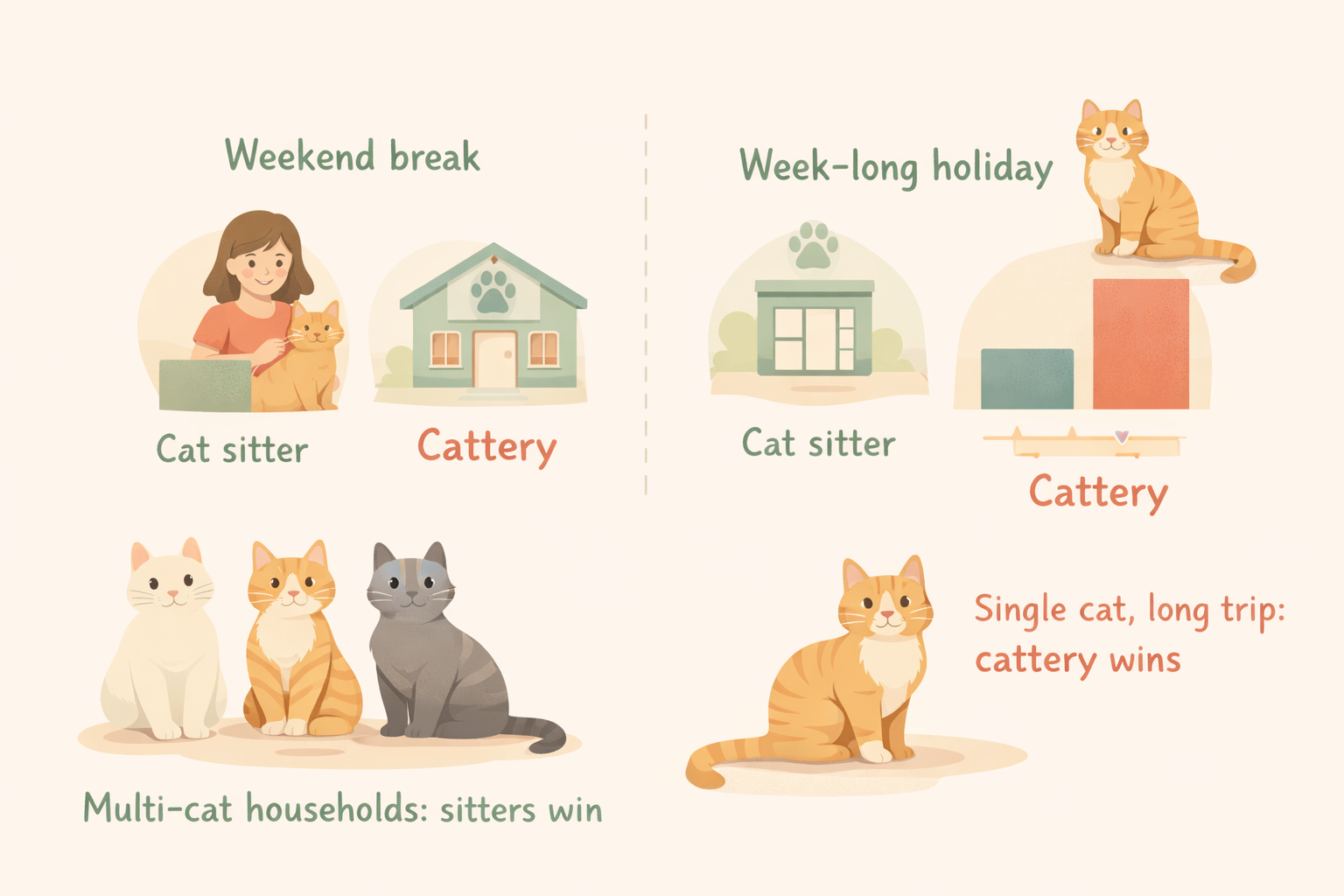
- Multi-cat households: Home sitting often works out cheaper and less stressful when you have several cats, sitters charge per visit, not per cat
- Supervision trade-off: Catteries provide on-site staff during operating hours; cat sitters leave your cat alone between visits
Cattery vs Cat Sitter at a Glance
| Aspect | Cat Sitter | Cattery |
|---|---|---|
| Environment | Your home, familiar territory | Purpose-built facility with other cats nearby |
| Supervision | 1-2 visits daily (30-60 mins each) | On-site staff during operating hours |
| Licensing (England) | Generally not required for in-home visits | Must hold local authority licence under 2018 Regulations |
| Routine | Follows your exact feeding and play schedule | Facility's standardised routine |
| Infection risk | Zero exposure to other cats | Low risk if vaccinated, higher for elderly/immunocompromised |
| Best for | Anxious, senior, medical-needs, multi-cat homes | Confident, sociable cats; longer holidays; owners needing 24/7 cover |
Cattery: Pros and Cons
The case for: Professional catteries provide on-site supervision during operating hours. Staff are trained to spot signs of illness or distress, and most have established relationships with local vets. For confident cats who adapt well to new environments, a well-designed cattery can actually provide enrichment, climbing structures, purpose-built play areas, and the stimulation of watching other cats from their individual space.
Licensed catteries in England must meet specific welfare standards under the 2018 Regulations, with regular inspections ensuring standards are maintained. That regulatory oversight is genuine reassurance.
The case against: The journey alone can be traumatic for many cats. An unfamiliar environment filled with other cats' scents and sounds compounds the stress. Individual attention is necessarily limited when staff care for multiple animals, your cat won't get the same personalised interaction they're used to at home. And despite vaccination requirements, the risk of picking up infections does increase around other cats, particularly for elderly or immunocompromised animals.
Cat Sitter: Pros and Cons
The case for: No travel stress. Your cat keeps their favourite spots, hiding places, and the comforting scents of home. A good sitter follows your exact routines, same feeding times, same food, same medication schedule. This consistency is invaluable for cats with medical conditions. Diabetic cats needing twice-daily insulin, for instance, can be managed perfectly well with morning and evening visits.
Zero exposure to other cats eliminates infection risk entirely. And your home gets a security bonus, regular visitor presence deters opportunistic burglars.
The case against: Between visits, your cat is alone. Most healthy adults cope well, but this isn't suitable for kittens, cats with serious medical conditions, or those prone to getting into trouble. If something goes wrong, an injury, a blocked cat flap, a water bowl knocked over, nobody's there to notice until the next visit. You're also dependent on one person's reliability. Professional sitters should have backup arrangements, but last-minute illness can leave you scrambling.
Cost Comparison
Cattery rates typically sit around £15-30 per night depending on location and facilities. Cat sitting generally costs £12-18 per visit, with most cats needing 1-2 visits daily.
For a weekend break (2 nights), you might pay £30-60 for a cattery versus £48-72 for sitting visits. For a week-long holiday, the gap widens: £105-210 cattery versus £168-252 for sitting. Catteries get proportionally cheaper the longer you're away.
Multi-cat households flip this calculation entirely. Catteries charge per cat; most sitters charge per visit regardless of how many cats you have. Three cats for a week: £315-630 cattery, still £168-252 for sitting.
Compare cat boarding options near you to see what's available in your area.
The Verdict
A cat sitter is probably right if your cat:
- Is anxious, nervous, or hides when strangers visit
- Is senior or has medical conditions needing consistent routines
- Has never been outside your home and would find a cattery environment jarring
- Hates car travel or gets extremely stressed at the vet
- Lives with other cats (cheaper and less disruptive for the whole household)
A cattery might be better if your cat:
- Is confident, adaptable, and has stayed in catteries before without issue
- Has a serious health condition requiring constant professional monitoring
- Lives somewhere where reliable sitters are hard to find
For first-timers with either option, try a short trip first, a weekend away rather than a fortnight. It gives you and your cat a chance to see how the arrangement works without a long commitment.
Find cat boarding options in your area to start comparing local catteries and sitters.
Red Flags to Watch For
Catteries: Always verify the licence with your local authority, don't just take their word for it. Avoid any facility that houses cats from different households together (individual accommodation is a legal requirement). Poor hygiene, strong ammonia smells, or reluctance to let you visit before booking are all walk-away signals. Any cattery that doesn't ask for vaccination certificates isn't taking biosecurity seriously.
Cat sitters: Reluctance to meet beforehand, no references, no backup plan for emergencies, and vague commitments about visit times. Professional liability insurance isn't legally required, but any serious sitter carries it, ask to see evidence.
Frequently Asked Questions
How far in advance should I book cat care?
2-3 weeks ahead for school holidays and Christmas. Off-peak, a week's notice is usually fine, though earlier booking gives you better choice, especially for popular sitters and catteries with limited capacity.
Can I switch between a cattery and sitter for different trips?
Absolutely. Many owners use catteries for longer holidays (better value) and sitters for weekends (less disruption). Your cat's needs may also change with age, a confident young cat might suit catteries, while the same cat in old age may prefer home care.
What vaccinations do catteries require?
Most licensed catteries require current certificates for cat flu (feline calicivirus and herpesvirus) and feline enteritis (panleukopaenia) at minimum. Some also require proof of worming. Check with your specific cattery, requirements vary.
Is cat sitting safe for cats with medical conditions?
For most conditions, yes, provided your sitter is experienced and comfortable administering medication. Diabetic cats, for example, can be well-managed with twice-daily visits. But cats needing round-the-clock monitoring (post-surgery, acute illness) are better in a cattery or veterinary facility where staff are always present.