
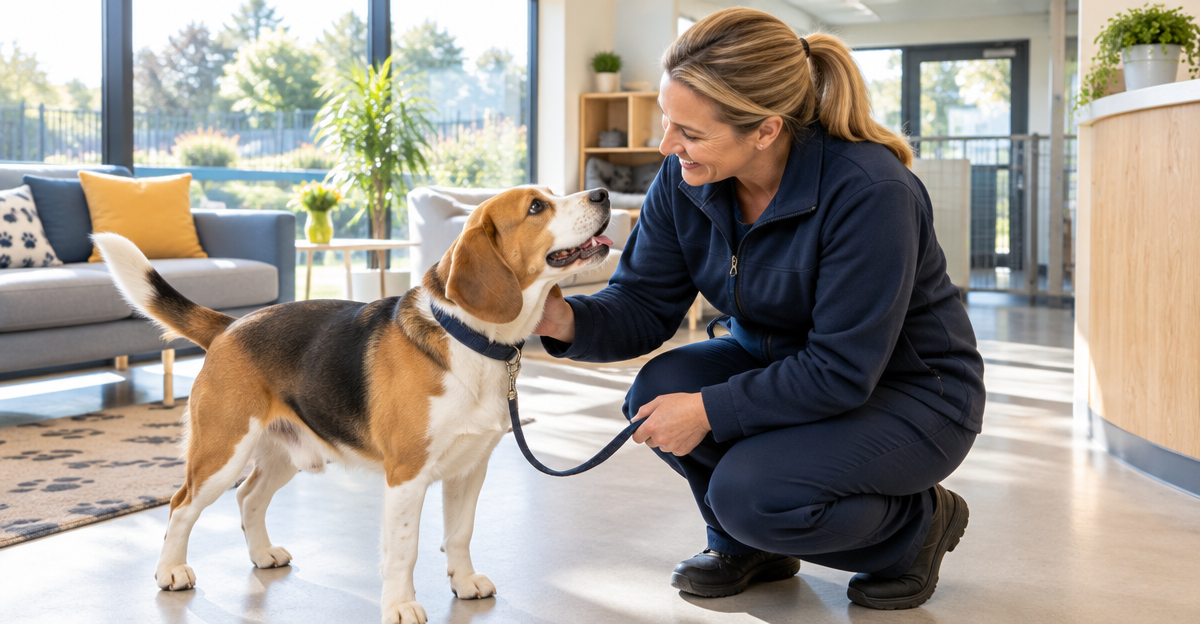
The Animal Welfare Act 2006 is the main law protecting pets in England and Wales. It applies to boarding kennels, catteries and home boarders just as it applies to owners. Anyone responsible for an animal must meet its welfare needs, and that includes the person looking after your pet while you are away.
This guide covers what the Animal Welfare Act 2006 means for pet boarding, how it differs from boarding licences, and how to check that your pet is in good hands.
Key Takeaways
- The Act applies in England and Wales only. Scotland and Northern Ireland have their own laws.
- It places a legal duty of care on anyone responsible for an animal, including boarding providers caring for a pet on the owner's behalf.
- Boarding licences are a separate system. In England, they fall under the Animal Welfare (Licensing of Activities Involving Animals) (England) Regulations 2018.
- You can check whether a boarder holds a current licence by contacting the local council.
- Your own duty of care continues while your pet is boarding, so choosing a competent provider matters.
What Is the Animal Welfare Act 2006?
The Animal Welfare Act 2006 sets out how animals in human care must be treated in England and Wales. The full text is on legislation.gov.uk.
It replaced a patchwork of older animal protection laws. The biggest change was a positive duty. People must now actively meet an animal's welfare needs. Before the Act, the authorities could usually only step in once cruelty had already happened. That shift is what makes the Act so relevant to boarding. A kennel does not have to be cruel to fall short. It only has to fail to provide what an animal needs.
Which Parts of the UK Does It Cover?
| Nation | Main animal welfare law |
|---|---|
| England | Animal Welfare Act 2006 |
| Wales | Animal Welfare Act 2006 |
| Scotland | Animal Health and Welfare (Scotland) Act 2006 |
| Northern Ireland | Welfare of Animals Act (Northern Ireland) 2011 |
The principles are similar across the UK, but the legal detail differs. If you are boarding in Scotland or Northern Ireland, the 2006 Act discussed here is not the law that applies. Our overview of UK pet laws on welfare, boarding and renting covers the wider picture.
Who Counts as a Person Responsible for an Animal?
The Act covers anyone responsible for an animal, whether permanently or temporarily. That means the owner, and it also means anyone who has charge of the animal for a short period.
So when you hand your dog to a kennel, a home boarder or a cattery, that provider takes on a legal duty of care for the length of the stay. Your own responsibility continues too. Both of you are accountable.
What Are the Five Welfare Needs?
Section 9 of the Act sets out five welfare needs. Each one must be met, taking into account the animal's species, age and circumstances. Here is what each need looks like in a good boarding setting.

The Need for a Suitable Environment
In boarding terms, this means clean, safe and comfortable accommodation. There should be enough space to move and rest, somewhere to get away from noise, and sensible control of heat and ventilation.
The Need for a Suitable Diet
This includes fresh water. A good boarder feeds your pet to its usual routine, follows any dietary or medical instructions, and keeps clean water available at all times.
The Need to Exhibit Normal Behaviour Patterns
Animals must be able to behave in ways that come naturally to their species. For dogs, that means regular walks, play, sniffing and time with people. For cats, it means places to climb, hide and scratch. A pet kept in a bare run all day is not having this need met, however clean the run is.
The Need to Be Housed With, or Apart From, Other Animals
The Act refers to housing animals with or apart from others, as appropriate, and this is where good boarders really show their worth. Some dogs love company. Others are anxious or reactive and are far happier on their own. Cats from different households should not normally share space at all.
The Need to Be Protected From Pain, Suffering, Injury and Disease
This need covers health and safety. In practice, it means vaccination requirements for incoming pets, secure fencing, prompt action if an animal is unwell, and a clear arrangement for vet access, including in emergencies. If you are boarding a dog, read our guide to the kennel cough vaccine before boarding, as most kennels will ask about it.
What Are the Offences and Penalties?
The Act creates separate offences for causing harm and for failing to meet welfare needs. Two matter most here.
- Section 4: causing unnecessary suffering to an animal.
- Section 9: failing to take reasonable steps to meet an animal's welfare needs.
Sections 32 to 34 set out penalties and post-conviction powers, including deprivation and disqualification orders. The Animal Welfare (Sentencing) Act 2021 raised the maximum prison sentence for the most serious animal cruelty offences in England and Wales to five years. Penalties vary by offence, so check the current position on gov.uk if you need precise detail.
Who Enforces the Act?
Local authority inspectors and the police have statutory enforcement powers. The RSPCA investigates complaints and can bring private prosecutions, but it has no statutory enforcement powers of its own. Many people assume otherwise.
How Does the Act Relate to Boarding Licences?
The 2006 Act sets the overall duty of care. Licensing is a separate system. In England, the 2018 Licensing Regulations set the conditions for businesses such as boarding kennels, catteries, home boarding for dogs and dog day care. When a kennel in England says it is licensed, this is the regulation behind that licence.
DEFRA (the Department for Environment, Food & Rural Affairs) is responsible for the legislation. It also publishes the statutory guidance that councils use when inspecting licensed boarders.
Licence conditions cover accommodation, feeding, exercise, health, emergency planning and staff competence. Councils usually assess premises against the statutory guidance and may award a star rating, which can affect how often a business is inspected. The guidance itself is on gov.uk if you want the detail.
Wales has its own licensing rules under separate legislation, so check with the relevant Welsh council rather than assuming the English rules apply.
One point is often misunderstood. Home boarding, where your pet stays in the carer's own home, is licensed in England too, and it is not a lighter-touch option than a kennel. By contrast, a house sitter who looks after your pet in your own home generally does not need a licence. For a fuller comparison of the options, see our guide to choosing a licensed kennel or home boarder.
What Does This Mean for You as a Pet Owner?
Your duty of care does not end at the kennel gate. You are still responsible for choosing a competent provider and giving them the information they need to look after your pet properly.
Before booking, it helps to:
- Ask to see the boarder's licence.
- Visit the facilities. Reputable providers will happily show you around.
- Confirm which vet they use and what happens in an emergency.
- Share your pet's medical history, medication, diet and behavioural quirks.
Red Flags That Welfare Needs May Not Be Met
- No licence, or reluctance to discuss it.
- Unwillingness to show you where your pet will stay.
- No emergency vet plan.
- Overcrowding, or too many animals for the number of staff present.
- No questions about your pet's routine, health or temperament.
If something feels off, trust that instinct. Handing over a much-loved pet is hard enough without lingering doubts, and there are plenty of good boarders out there.
How Can You Verify a Boarder Is Meeting Their Legal Duties?
Start with the local council, because it issues boarding licences. You can find the right council through the gov.uk "find your local council" service and ask whether a business holds a current licence. It takes a few minutes and is the most reliable check available to you.
Beyond that:
- Look for a displayed licence and any star rating when you visit.
- Ask about staff training and how many animals each person looks after.
- Ask about emergency procedures, for example in a fire or if an animal falls ill.
- Ask whether they carry insurance. Most do, although it is not a requirement of the 2018 Regulations.
A directory is a sensible place to begin. At the time of writing, our directory lists 2,703 pet hotels, with the highest numbers in London (31), Leeds (25) and York (25). You can find options near you on Tailstays and build a shortlist, but always confirm the current licence directly with the provider and the council before booking.
Trust Signals of a Well-Run Boarder
The red flags above show what to avoid. This is what good looks like:
- A displayed licence and star rating that the boarder is happy to talk through.
- Clear written policies covering bookings, cancellations, feeding, exercise and what happens if your plans change.
- Vaccination checks for every incoming animal, which protect your pet from disease.
- Transparent emergency vet arrangements, including the named vet and how they will contact you.
- Detailed questions about your pet before they accept the booking. A boarder who wants to know everything is usually a good sign.
- Recent, consistent reviews from other owners, ideally mentioning communication and updates during the stay.
- An open door: they let you look around and explain how staff are deployed.
What Should You Do If You Have a Welfare Concern?
- Raise it with the provider first. Many problems turn out to be misunderstandings and can be resolved quickly.
- Report it to the local authority if you are not satisfied or the issue is serious. The council licenses boarders and can investigate.
- Contact the RSPCA if you suspect cruelty. Check its website for the current helpline number.
- Keep records. Save messages, dates and photographs of anything that worries you.
If your pet needs urgent medical attention, take them to a vet first and sort out the paperwork afterwards.
Frequently Asked Questions
Does the Animal Welfare Act 2006 apply to boarding kennels and home boarders?
Yes. The Act applies to anyone responsible for an animal, including people caring for it temporarily. Kennels, catteries and home boarders all owe a duty of care to the animals they look after.
Does the Animal Welfare Act 2006 apply in Scotland and Northern Ireland?
No. It covers England and Wales. Scotland has the Animal Health and Welfare (Scotland) Act 2006, and Northern Ireland has the Welfare of Animals Act (Northern Ireland) 2011.
What are the five welfare needs?
Under Section 9, they are the need for a suitable environment, the need for a suitable diet, the need to exhibit normal behaviour patterns, the need to be housed with or apart from other animals, and the need to be protected from pain, suffering, injury and disease.
Is it illegal to leave a dog alone while on holiday?
The Act does not set a fixed time limit. It requires that your dog's welfare needs are met, which means food, water, company, chances to go to the toilet and care if something goes wrong. Leaving a dog entirely alone for a holiday would almost certainly fail that test. Arrange a licensed kennel or home boarder instead, or a house sitter who cares for your pet in your own home.
Who can I report a boarding facility to?
Start with your local council, which licenses boarders in England. For suspected cruelty you can also contact the RSPCA, and the police can act where an offence may have been committed.
Is the Animal Welfare Act the same as a boarding licence?
No. The 2006 Act sets the general duty of care for animals. In England, boarding licences are issued under the separate 2018 Regulations, which set the specific conditions a business must meet to operate.