
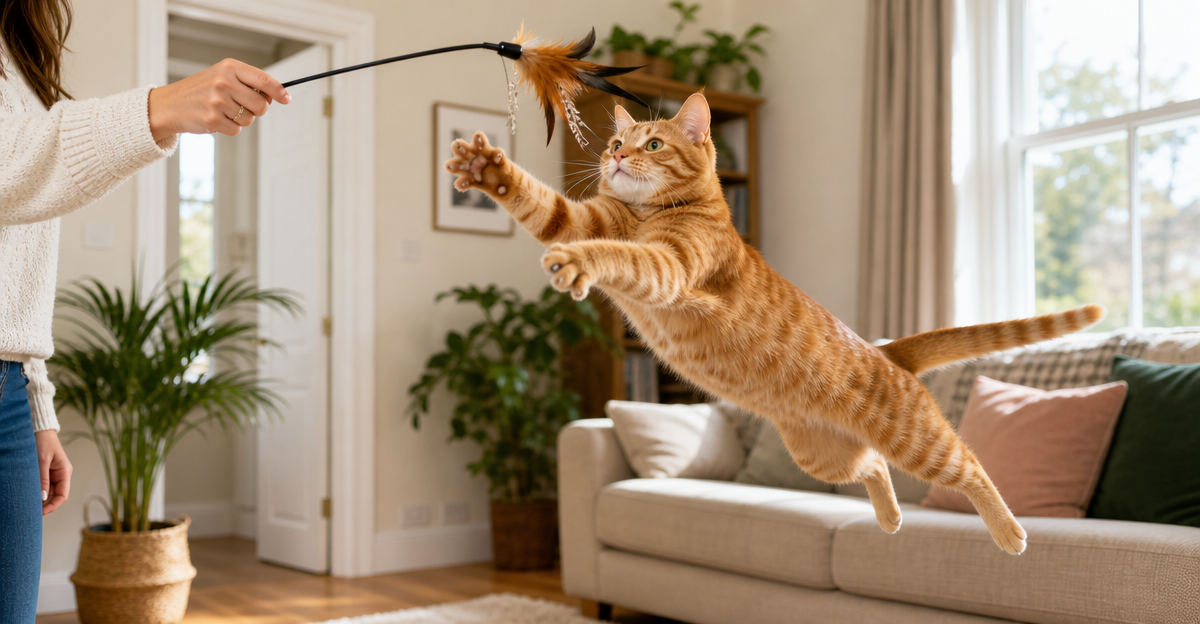
Indoor cats live longer on average than their outdoor counterparts, but that safety comes with a trade-off: they need you to bring the action to them. Without enough physical and mental stimulation, boredom sets in fast, and boredom in cats tends to show up as weight gain, destructive scratching, or attention-seeking behaviour that drives you quietly mad at 3am.
The good news is that keeping an indoor cat genuinely active doesn't require a huge budget or a specialist degree. It just requires a little thought and some consistency.
Key Takeaways
- Indoor cats need both physical exercise and mental stimulation, one without the other isn't enough.
- Two short play sessions a day are generally more effective than one long session.
- Vertical space, cat trees, shelving, wall-mounted perches, is one of the most underrated tools for feline fitness.
- Puzzle feeders and foraging games tap into natural hunting instincts and slow down fast eaters.
- A cat that suddenly becomes lethargic or disinterested in play warrants a vet visit, it can signal an underlying health issue.
- Rotating toys regularly keeps things novel; most cats lose interest in the same toy within days.
Why Indoor Cats Need Structured Exercise
In the wild, a cat's day is built around hunting, stalking, sprinting, pouncing, resting, then starting again. An indoor cat has none of those natural triggers. Unless you recreate them, she'll spend most of the day asleep on the sofa, which is lovely for cuddles but not great for her waistline or her mind.
PDSA PAW Reports have consistently identified obesity as one of the most common health problems in UK pet cats. Excess weight puts strain on joints, increases the risk of diabetes, and shortens life expectancy. Regular, varied exercise is one of the most straightforward ways to help manage it, alongside diet, of course.
Interactive Play: The Foundation of Indoor Exercise
No piece of kit replaces you. Cats are triggered by movement that mimics prey, unpredictable, erratic, fleeing. That's something a static toy on the floor simply can't replicate. Interactive wand toys (feathers, ribbons, crinkle lures on a flexible rod) are the closest thing to a genuine hunt your living room can offer.
The key is how you use them. Drag the toy behind furniture. Make it dart under a blanket. Let it "escape" and pause, then dart again. Most cats disengage quickly if prey moves in a robotically predictable line. Two sessions of 10-15 minutes a day is a reasonable target for most adult cats; kittens and younger cats will happily go longer.
Always end a play session with a "kill", let your cat catch the toy and hold it for a moment. Cats that never "succeed" can become frustrated, and a frustrated cat is usually a mischievous one.
Vertical Space: Think Upwards
Floor space is finite in most UK homes. Vertical space, though, is often almost entirely unused. Cats are natural climbers, height gives them security, vantage points, and a genuine physical workout. A cat that leaps between wall-mounted shelves at different heights is burning far more energy than one padding from sofa to food bowl.
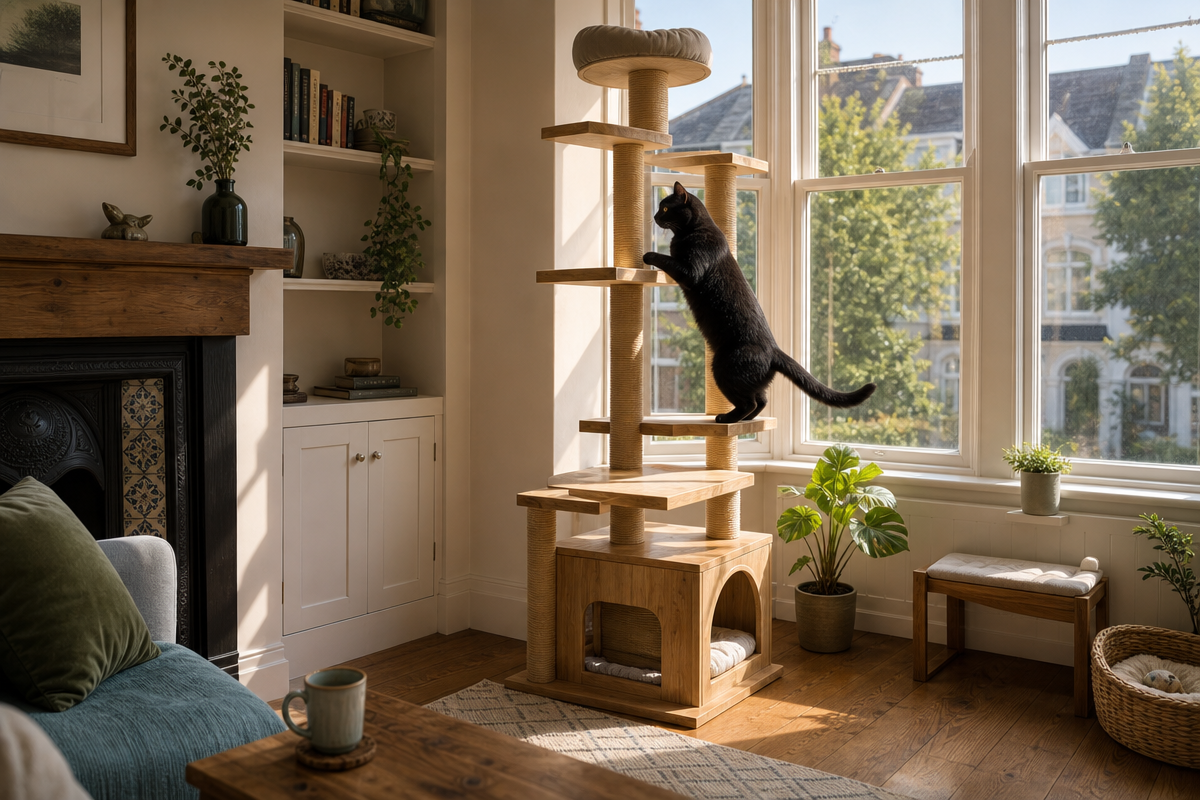
Cat trees remain the most popular option, and a tall, sturdy model with multiple platforms will serve most cats well. If you're short on floor space, wall-mounted cat shelves (sometimes called "catwalks") are increasingly popular and can be arranged to create a circuit around a room. Some owners go further with full cat shelving walls, which look striking and give multi-cat households room to establish their own territories at different heights.
Scratching posts do double duty, they keep claws healthy and allow cats to do a satisfying full-body stretch that works the muscles along the spine and shoulders. Tall sisal posts are generally more effective than short, wobbly ones; cats need to stretch fully upwards to get the benefit.
Puzzle Feeders and Foraging Games
Mental exercise tires a cat out almost as effectively as physical activity, and often more sustainably. Puzzle feeders replace the straight-line journey from bag to bowl with something that actually engages your cat's brain.
There's a wide spectrum available, from simple slow-feeder bowls to multi-stage puzzle boards where cats have to slide, lift, or bat components to release kibble. If you're not sure where to start, a scrunch of paper or a muffin tin with kibble hidden under tennis balls costs nothing and works just as well as expensive proprietary feeders.
Scatter feeding is another underused option, simply spreading dry food across a textured mat or even the kitchen floor forces your cat to use her nose and move around to find it, replicating a basic foraging pattern. It's particularly useful for cats that bolt their food and then immediately beg for more.
Solo Toys and Environmental Enrichment
Interactive play with you is irreplaceable, but cats also need things to do when you're not around. The trick is novelty, most cats lose interest in a toy within a few days of exposure, so rotation is essential. Keep a selection and cycle them in and out every few days rather than leaving everything available at once.
A few types that tend to hold attention longer than average:
- Motorised or battery-operated toys, especially those with unpredictable movement patterns. Check reviews before buying; cheap models often move in repetitive circles that cats quickly learn to ignore.
- Crinkle balls and foil balls, lightweight, unpredictable when batted, and satisfying to carry around.
- Tunnels, collapsible cat tunnels give cats somewhere to ambush toys from (and ambush your ankles).
- Paper bags and cardboard boxes, genuinely exciting to many cats, particularly with a small toy hidden inside.
Window perches deserve a mention too. A bird feeder positioned outside a window gives your cat what's sometimes called "cat TV", hours of stimulation that requires no effort from you at all. It won't replace exercise, but it keeps a cat engaged and mentally occupied during the day.
Training: Yes, Really
Cats are trainable. It surprises many owners, but cats respond well to positive reinforcement with high-value treats, and training sessions double as mental exercise and bonding time. Basic tricks, sit, high-five, jumping through a hoop, are achievable with most cats and provide cognitive engagement that general play doesn't.
Clicker training is a popular method. Keep sessions short (five minutes maximum) because cats bore quickly, and always end on a success. Some cats take to it immediately; others need a few sessions to understand the concept. Don't write yours off after one attempt.
Leash training for indoor cats is also worth mentioning. It's not for everyone, and not every cat will tolerate a harness. But for cats that do take to it, a supervised garden walk or patio sit provides genuine outdoor stimulation without the risks of free roaming. Always use a well-fitted cat harness rather than a collar, and introduce it gradually at home before venturing outside.
Multi-Cat Households: Exercise With Added Complication
If you have more than one cat, exercise dynamics get more complex. Some cats play together enthusiastically; others coexist as reluctant flatmates who want nothing to do with each other's toys. Don't assume your cats will entertain each other.
In multi-cat homes, vertical space becomes even more critical, it allows cats to establish separate territories at different heights and reduces tension. Multiple scratching posts, food stations, and litter trays in different locations help prevent resource guarding, which is a common source of stress in houses where cats are forced into too-close contact.
If you notice one cat consistently preventing another from accessing toys, food, or the best perch, that's worth addressing, chronic low-level stress affects a cat's physical health as well as her behaviour. A behaviourist referral from your vet is a sensible step if the dynamic isn't improving.
When to Talk to Your Vet
A sudden drop in activity or interest in play is worth taking seriously. Cats are notoriously good at masking pain and illness, and a cat that's gone quiet is sometimes a cat that's struggling. If your usually playful cat abruptly loses interest in toys, stops jumping to her usual spots, or seems stiff getting up, book a vet appointment rather than assuming she's just having an off day.
Similarly, if you're trying to introduce an exercise routine because your cat is already overweight, it's worth a vet conversation first. Rapid exercise in an obese cat can put strain on joints. Your vet can help you build up activity gradually and assess whether dietary changes are needed alongside movement.
Frequently Asked Questions
How much exercise does an indoor cat actually need each day?
Most adult indoor cats benefit from around 20-30 minutes of active play daily, ideally split into two shorter sessions. Kittens and younger cats need more, they'll often tell you when they've had enough by simply walking away. Senior cats may need gentler, shorter sessions, particularly if they have joint issues. The goal isn't a set number of minutes so much as consistent daily engagement that gets your cat moving and thinking.
My cat just isn't interested in toys, what am I doing wrong?
Probably nothing. Some cats are naturally less playful than others, and many cats learn to be picky about toys. A few things worth trying: play when your cat is already alert and awake (usually dawn and dusk, when natural hunting instincts peak), try different toy types rather than assuming wand toys are universal, and make sure toys are moving away from your cat rather than towards her, prey runs away. If your cat has never shown interest in play, a vet check is sensible to rule out underlying discomfort.
Can I use a laser pointer for exercise?
Laser pointers can be an effective way to get a cat moving, but they come with a caveat: cats never actually catch the light, which can leave some individuals frustrated or anxious over time. If you use one, always transition to a physical toy at the end of the session so your cat gets the satisfaction of a "catch." Laser pointers are best used as a supplement to wand toys rather than a replacement.
Is it cruel to keep a cat indoors permanently?
Not inherently, but it does place the responsibility for enrichment firmly on you. Cats kept exclusively indoors can live full, healthy, contented lives if their environment is stimulating enough. Many vets and welfare organisations actually recommend indoor living in areas with heavy traffic, high predator pressure, or certain disease risks. The RSPCA notes that cats can adapt well to indoor life provided they have sufficient mental and physical stimulation, space, and social interaction.
What's the difference between physical exercise and mental stimulation for cats?
Physical exercise covers activities that get your cat's body moving, running, jumping, climbing, pouncing. Mental stimulation engages her brain, puzzle feeders, foraging, training, watching birds outside. Both matter, and they're not interchangeable. A cat that's physically tired but mentally bored will still find trouble to get into. Ideally, your daily routine incorporates both, and the good news is that many activities (interactive play, training) deliver both at once.