

Travelling with cats is possible, but most cats would much rather stay put. If your cat is nervous, elderly or unwell, or you are away for more than a short trip, a licensed cattery or a visiting sitter is often the kinder choice.
This guide will help you make that call honestly. If your cat is coming with you, it also covers how to do it well, from carrier training to what to watch for once you arrive.
Key Takeaways
- Most cats are not natural travellers. They bond strongly to their home territory.
- Assess your own cat honestly: a one-hour vet trip is very different from a week-long holiday somewhere unfamiliar.
- For many cats, a licensed cattery or home visits from a sitter is the lower-stress option.
- When comparing providers, ask to see the licence and ask to visit first. Walk away if either is refused.
- If your cat does come along, the carrier matters most. Choose a secure one and start getting your cat used to it weeks ahead.
- Never leave a cat in a parked car, even briefly, and especially in a UK summer.
- International trips add months of lead time, a rabies jab and an Animal Health Certificate.
How to Decide: Travel With Your Cat or Arrange Care
The decision usually comes down to two things: the cat you actually have, and the trip you are actually planning. Start with your cat.
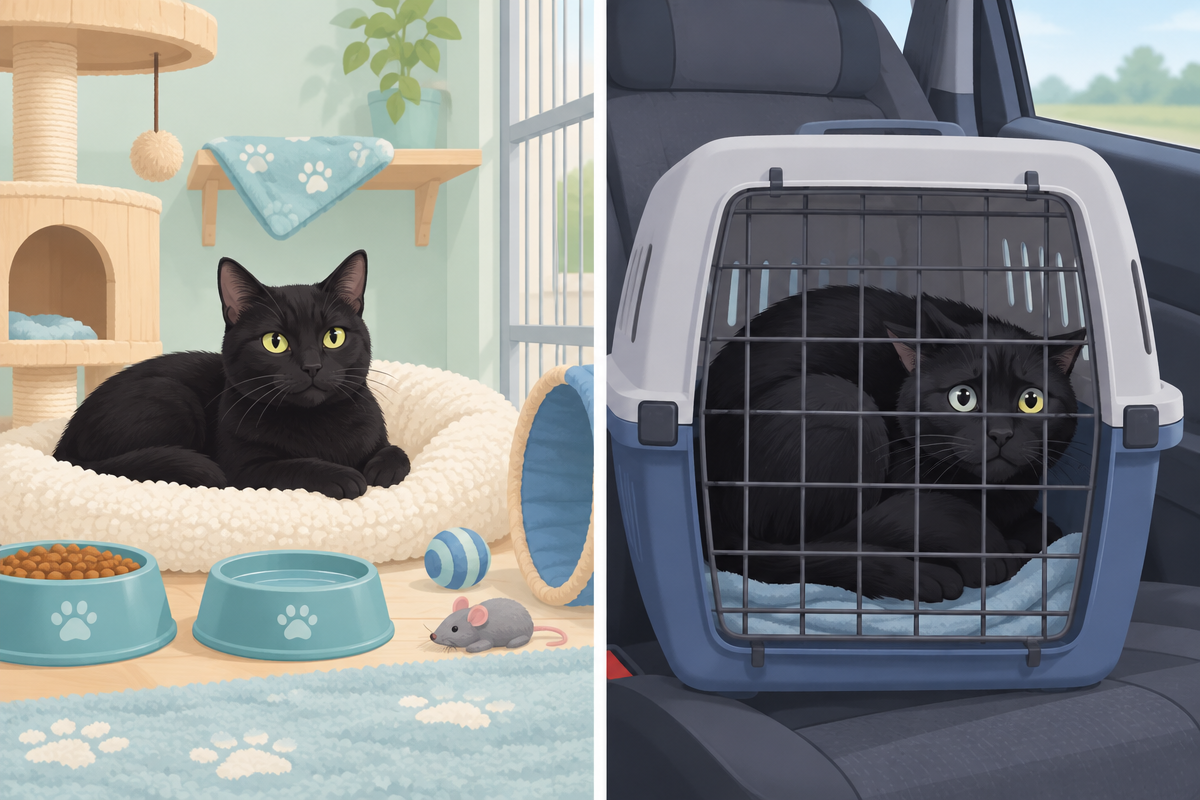
Is your cat a good traveller?
Take your cat only if they are confident, healthy and used to a carrier, and the trip is a sensible length. It is tempting to hope they will cope. It is better to judge them on how they have behaved before.
Signs your cat may cope with travel
- They are confident and curious in new places rather than freezing or bolting.
- They have had good experiences of car journeys before, not just trips to the vet.
- They are young and healthy.
- They walk into their carrier without a fight, and may even nap in it.
Signs your cat is better off staying home
International Cat Care (iCatCare) points out that most cats are not particularly happy travellers because they are strongly bonded to their own territory, where everything is familiar and feels safe. Away from it, they face new sights, sounds and smells, plus unfamiliar animals and people.
Your cat is likely better off at home if they are:
- Very territorial, or easily unsettled by changes in routine.
- Elderly, or living with a health condition such as kidney disease, heart problems or arthritis.
- Prone to strong stress responses: howling, drooling, vomiting or hiding for days after a vet visit.
- Pregnant, or a kitten under three months old. iCatCare advises against travelling with them.
If you have ever watched your cat spend a whole evening under the bed after a short drive, take that seriously. It is the most useful evidence you have.
Short trips versus a holiday
A one-hour drive to the vet is a contained, temporary stress. A week away means a long journey, a strange room, unfamiliar smells and little chance to retreat somewhere safe. An unsettled cat may stop eating, hide constantly or try to escape. Plenty of cats that tolerate a short trip are still far happier left in familiar surroundings for a longer break.
Travel, sitter or cattery: comparing the options
If your cat is a maybe or a no, it helps to see the three main options side by side.
| Factor | Travel with your cat | Home visits (sitter) | Cattery boarding |
|---|---|---|---|
| Stress on cat | Highest for most cats: carrier, journey, new place | Lowest: familiar territory and routine | Moderate: new place, but no journey for most of the stay |
| Company | You are with them | Short visits, so long stretches alone | Daily staff attention |
| Licence needed | No | Generally no licence when the sitter works in your own home | Yes, in England under the 2018 Regulations |
| Best for | Confident, young, healthy cats on shorter trips | Settled, territorial or elderly cats | Cats that need regular supervision or medication, or owners away for a long time |
Going abroad? International trips from Great Britain add months of lead time, a microchip, a rabies vaccination with a waiting period, and an Animal Health Certificate (AHC) from an official vet shortly before travel, plus requirements for the return journey. Rules differ for Northern Ireland. Check the official GOV.UK pet travel page before you book, and see our guide to taking your cat abroad after Brexit. Honestly, for most cats a cattery at home is far simpler and kinder than a trip overseas.
Finding a licensed cattery or sitter
In England, catteries and cat home boarding require a licence under the Animal Welfare (Licensing of Activities Involving Animals) (England) Regulations 2018. Wales has similar requirements under separate legislation. Scotland does not currently have consistent national licensing for cat boarding, so check carefully there. In Northern Ireland, whether licensing applies can depend on the council and the type of setup, so ask the provider directly.
Our directory lists 2,703 hotels, so you can compare providers near you and check which ones cater for cats. You can also browse city pages such as London (31 hotels), Leeds (25) and York (25). Shortlist two or three, and book early for school holidays and summer, when good catteries fill up fast.
Questions to ask and red flags
Ask each provider:
- Can I see your licence, and when was the last inspection?
- Are cats housed away from dogs, so they are not stressed by noise and smells?
- Is the building escape-proof, with double doors or similar safeguards?
- What vaccinations do you ask for?
- How do you handle medication, illness and vet emergencies?
- Can I visit first?
If you are not sure your cat's jabs are current, our cat vaccination schedule explains what is typically needed.
Red flags to walk away from:
- They refuse or avoid showing a licence where one is required.
- They will not let you visit first. Reputable providers usually welcome it.
- Cats are housed close to dogs.
- They ask for no vaccination proof at all.
- There is no clear plan for illness, medication or vet emergencies.
- Doors or runs look easy for a cat to escape from.
For a sitter, ask about their experience with cats, their backup plan if they fall ill, how often they will visit, and whether they hold insurance.
Booking a cattery or sitter
If a provider passes your checks, book it, share your vet's details and your cat's routine, and leave some familiar bedding. Our cat boarding checklist covers what else to pack for a cattery stay.
How to Travel With Your Cat Safely
If you have decided your cat is coming along, preparation makes a real difference. Most of it happens weeks before you leave.
Choosing and introducing a carrier (start 2-4 weeks before)
iCatCare recommends solid plastic carriers. They are easy to clean, have secure doors and a top half that lifts off, which lets a vet examine your cat without dragging them out. For more detail on sizes and features, see our guide to choosing the right cat travel carrier.
| Carrier type | Good for | Watch out for |
|---|---|---|
| Hard plastic | Car, train, vet visits. Easy to clean, secure, removable top | Bulky to store |
| Fabric | Light and easy to carry | Harder to clean, can sag, and determined cats can push zips open |
| Wicker | Looks traditional | Hard to clean, can be chewed or scratched, doors can be weak |
| Backpack | Confident cats on short trips | iCatCare notes backpacks can have poor ventilation and give no hiding place |
Some brands, such as the US adventure-cat company Outdoor Bengal, promote backpacks and harnesses as the default way to travel. That reflects a particular adventure-cat view of travel. For the average UK house cat, treat a backpack as an option for very confident cats only.
To get your cat used to the carrier:
- Leave the carrier out in a room your cat uses, door open, all the time.
- Put familiar bedding inside, ideally something that smells of home.
- Drop treats in and near it, then feed some meals inside it.
- Once your cat goes in happily, close the door for a few seconds, then build up gradually.
- Try a short walk around the house, then a short car trip that ends somewhere pleasant.
- If you use a feline pheromone spray, iCatCare suggests spraying the carrier and waiting 15-20 minutes before putting your cat in.
In a multi-cat household, use one carrier per cat. Cats that get on well at home can redirect stress onto each other in a confined space.
Health and ID checks
- Make sure your cat is microchipped with up-to-date details. Microchipping became compulsory for cats in England on 10 June 2024. Scotland, Wales and Northern Ireland have their own rules.
- Ask your vet to confirm your cat is fit to travel, and check that vaccinations and flea and worm treatments are current.
- If your cat gets very anxious, talk to your vet. Never give sedatives or human medicines yourself.
On the day of travel
iCatCare suggests withholding food for around 4-5 hours before travel to reduce travel sickness, while still allowing water. Follow your vet's advice instead if your cat has a health condition, particularly diabetes.
Pack absorbent pads, spare bedding, wipes, bin bags, litter and a small tray, a collapsible bowl, water, treats, your cat's usual food, and your vet's details and microchip number.
Car, train, air and sea
- Car: Never let your cat roam loose. Secure the carrier in the footwell behind a front seat, or on the back seat with a seatbelt. Do not put it in the boot. Keep the car cool and out of direct sun.
- Never leave a cat in a parked car. Even on a mild UK day, the inside of a car can heat up dangerously fast. Plan stops so you never need to leave your cat alone in it.
- Train: Rules vary by operator, so check National Rail or your train company. Cats are commonly expected to be in a carrier.
- Flying: iCatCare notes most airlines carry cats in the hold, and some do not carry pets at all. Flying is stressful and carries real risks, so think very carefully before choosing it.
- Ferries and coaches: Policies differ widely. Ask the operator about cats specifically and get the answer in writing.
Settling in and signs of stress
Give your cat one small, secure room first and let them come out of the carrier in their own time, with water, a little food and familiar bedding. Check windows, doors, chimneys and gaps behind furniture before you open the carrier. On a holiday stay, your cat should not go outdoors at all.
Many UK pet-friendly listings are written with dogs in mind, so ask whether cats are specifically allowed, and check fees, whether your cat can be left alone in the room, and any litter tray rules.
Some stress is normal on a journey. Persistent or severe signs are not, and if in doubt, call a vet:
- Panting or open-mouth breathing
- Heavy drooling
- Excessive or distressed vocalising
- Hiding and refusing to come out for a long time
- Vomiting
- Refusing to eat or drink after you arrive
Heatstroke is an emergency. Signs can include rapid panting, drooling, bright red gums, weakness, vomiting and collapse. Move your cat somewhere cool and call a vet straight away.
Still unsure whether your cat should come? Browse cat boarding on Tailstays and see what is available for your dates.
FAQ
Is it cruel to travel with a cat?
Not necessarily, but it is stressful for most cats. If your cat is confident and healthy and the trip is short, it can be fine. If they are nervous, elderly or unwell, leaving them in familiar surroundings with good care is usually kinder.
Is a cattery or a cat sitter better for my cat?
A sitter suits settled, territorial or elderly cats that do best at home. A licensed cattery suits cats that need daily supervision or medication, or owners who are away for a long time. Either way, check credentials before you book.
How long can a cat go in a car?
There is no single safe limit, because it depends on your cat. Plan regular stops on long journeys, keep the car cool, and never open the carrier or let your cat out in the car or at a service station.
Can I take my cat to Europe from the UK?
Yes, for most EU trips, provided your cat is microchipped, vaccinated against rabies and has an Animal Health Certificate. Check the GOV.UK pet travel page for current timings and rules, and allow plenty of time. If that sounds like a lot for a short break, compare boarding near you on Tailstays.
Do cats need a harness for travel?
A harness is not essential if your cat travels in a secure carrier. It can help confident cats during breaks, but only if they have been trained to wear one, and never as a replacement for a carrier in a vehicle.