
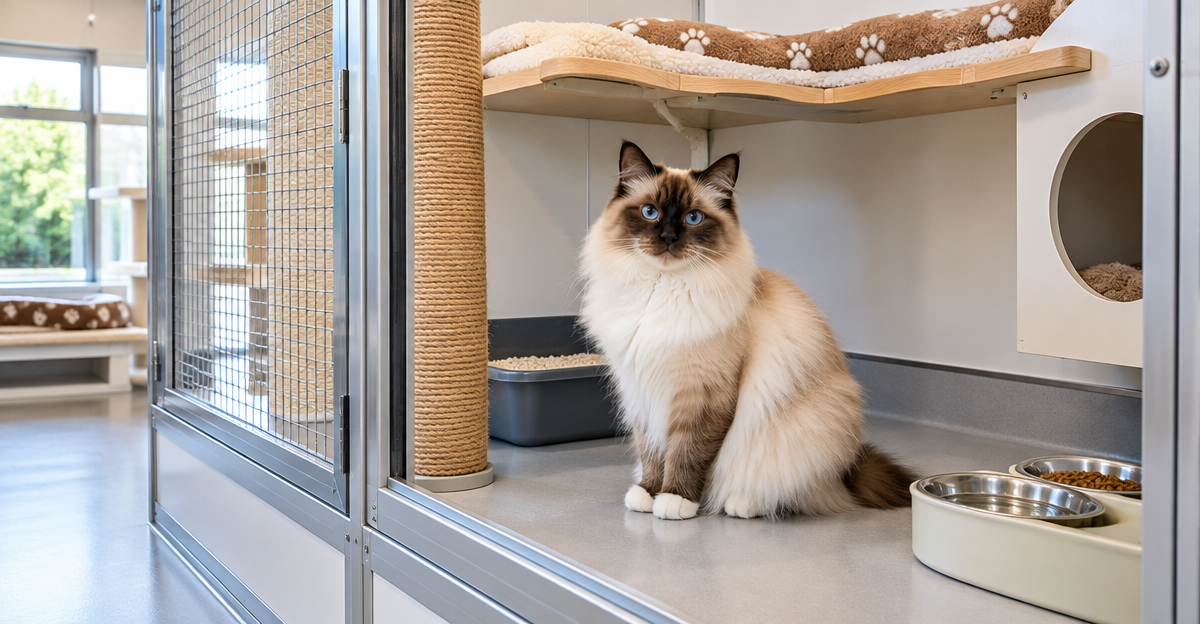
Cat boarding in Warrington means using a cattery licensed by Warrington Borough Council, or a home-based carer who holds the same kind of licence. Which is right for you depends on your cat's temperament, your travel plans and how much you can check in person before you book.
Leaving a cat behind is rarely easy. Cats tend to notice change more than dogs do, and it's natural to worry whether yours will eat, settle and feel safe. The good news is that a little homework on licensing, vaccinations and the cattery itself takes most of that worry away.
Key Takeaways
- Catteries in Warrington are licensed by Warrington Borough Council under the 2018 Regulations. Ask to see the licence and the star rating.
- Don't take a displayed rating or licence number on trust. Confirm it with the council.
- Proof of up-to-date vaccinations is normally required, and some catteries refuse admission without it (and may still charge you).
- Book early for school holidays and Christmas, when opening hours can also be restricted.
- The M6 and M56 make drop-off simple for commuters and for travellers heading to Manchester Airport.
- You can browse and compare local options on Tailstays and then request to book directly with the cattery.
What Cat Boarding Is Available in Warrington?
Warrington has a mix of dedicated catteries, combined kennel and cattery sites, and some home-based carers. Each suits a different kind of cat, so it helps to know the differences before you start calling round.
Dedicated Catteries vs Combined Kennels and Catteries
A dedicated cattery only boards cats. A combined site, often a farm-based business, boards dogs and cats under one roof or on one plot. Rose Tree Farm Boarding, for example, describes itself as a kennels and cattery on a country site near Warrington, Widnes and Runcorn.
Neither is automatically better. Combined sites can be excellent when the cat accommodation is properly separated from the dog kennels. Even so, a cat-only site is often calmer: no barking, and no dog smell drifting past a nervous cat. If yours is easily rattled, ask exactly how the cat area is kept apart from any dogs on site.
Where They Tend to Be Located
Catteries need space, so many sit on the semi-rural edges of Warrington rather than in the town centre. That puts several within easy reach of the motorways and of the Widnes and Runcorn catchment.
For drivers, that's a real advantage. Tan House Farm Cattery, for instance, says it is around five minutes from the M6 and M56. Still, check the actual drive from your own front door, and allow extra time for rural lanes and rush hour at the motorway junctions.
Pet Hotels and Home-Based Boarding as Alternatives
Pet hotels usually offer more upmarket rooms and extras, which suits owners who want a higher level of comfort or a wider range of services. Home-based boarding places your cat in a carer's house with fewer cats around. For a shy or older cat, or one used to being the only cat at home, that quieter setting can be far less overwhelming than a larger cattery.
In England, home boarding for cats also needs a licence under the 2018 Regulations. It isn't a looser option, just a different setting with its own conditions.
How Are Warrington Catteries Licensed and Inspected?
Under the Animal Welfare (Licensing of Activities Involving Animals) (England) Regulations 2018, anyone boarding cats as a business in England needs a licence from their local authority. In Warrington, that's Warrington Borough Council. (Wales has similar requirements under separate legislation, and Scotland and Northern Ireland have their own arrangements.) Our guide to UK pet laws on welfare and boarding covers the wider picture.

What the Licence and Star Rating Cover
The licence sets conditions the operator must meet, covering accommodation, cleanliness, feeding, disease control, supervision and emergency planning. Licensed premises are inspected regularly by the council.
Councils also give licensed businesses a star rating, which affects how often they're inspected: higher-rated businesses may be visited less often. Stars reflect both welfare standards and how well the business is run, so treat a high rating as a strong sign rather than the whole story. You still need to see the place for yourself.
How to Verify a Licence
Reputable catteries display their licence and are happy to show it. Some also publish their licence number and rating online. Croft Cats, for example, states on its website that it was awarded 5 stars by Warrington Borough Council and gives a licence number. Rose Tree Farm publishes a boarding licence number too.
Treat these as claims to confirm, not proof. Checking takes a few minutes:
- Ask the cattery for its licence number and current star rating.
- Contact Warrington Borough Council's licensing team and confirm that the licence is current and covers cat boarding.
- Check that the licence is for the premises you'll actually be visiting.
Red Flags
- No licence displayed, or vagueness when you ask about it.
- Reluctance to let you view the accommodation. Reputable providers welcome visits.
- No vaccination policy, or a relaxed attitude to proof of vaccinations.
- Cats from different households sharing pens or communal space.
- Claims such as "fully licensed and insured" that can't be backed up with paperwork. Insurance is common among operators but isn't a legal requirement under the 2018 Regulations, so ask to see cover rather than assuming it.
What Local Factors Should Warrington Cat Owners Consider?
Warrington sits between Manchester and Liverpool, and that position, plus its motorway links, shapes both when catteries fill up and how easy they are to reach.
Christmas, Easter and Summer Demand
Christmas, Easter and the summer holidays fill up first, because demand climbs the moment schools break up. Our advice is simple: if you know your dates, book the cattery before you book the flights, not after. Short-notice bookings in peak weeks often mean settling for somewhere that wasn't your first choice.
Christmas brings a second complication in the form of restricted opening hours. Tan House Farm, for example, listed shortened hours on Christmas Eve and was closed on Christmas Day in its 2025 schedule. These details change from year to year, so check the current arrangements and plan your drop-off and collection days around them.
Airports and Motorway Access
Manchester Airport is the obvious hub for many Warrington residents, with Liverpool John Lennon Airport as another option. Tan House Farm says it is about ten minutes from Manchester Airport. Wherever you board, allow for traffic on the M6 and M56, particularly on Friday afternoons and at the start of school holidays. And check that an early flight actually fits the cattery's drop-off hours, because it's an easy thing to overlook.
Weather and Seasonal Issues
Cold, wet winters mean you should ask how a cattery keeps pens warm and dry. In hot spells, outdoor runs can get uncomfortable, so ask about shade, ventilation and how cats are kept cool. A good cattery will have clear answers to both.
How Do You Choose a Cattery in Warrington?
Most owners can get from a blank page to a confirmed booking in a week or two, so start well before your travel dates.
Shortlisting by Drive Time and Licence
Start with drive time from home. If you're flying from Manchester Airport, a cattery near the M56 can make departure day easier. If you commute along the M6, one close to your route helps with drop-off and pick-up. Then confirm that each cattery on your list holds a current licence.
To get started, see catteries listed in Warrington on Tailstays and compare providers before contacting them directly.
Vaccination and Health Requirements
Most catteries require proof of up-to-date vaccination against cat flu and feline infectious enteritis, and many also ask for recent flea treatment. Policies differ, so ask each cattery what it needs and whether a booster must be given a certain number of days before arrival. If you're unsure where your cat stands, our cat vaccination schedule guide explains the usual timings.
Croft Cats states plainly that it will refuse admission without a valid certificate and that cancellation charges may still apply. That's a fair policy, since it protects every cat on site, but it's a costly surprise if you haven't checked your cat's dates. Look at the card weeks ahead, not the night before.
On drop-off day, have these ready:
- Vaccination card or certificate showing current cover
- Flea and worming treatment dates, if requested
- Details of any ongoing health conditions
- Your vet's name and contact number
For bedding, food and the other things worth packing, see our cat boarding checklist.
What to Look For on a Viewing
A viewing is good practice rather than a legal requirement, but any cattery worth using will welcome one. Keep your checklist short:
- Secure double-door entry, clean pens with indoor and outdoor space, and comfortable heating and ventilation.
- Your cat alone in its pen unless it's sharing with a cat from your household.
- 24-hour supervision, or a clear explanation of what happens overnight.
- Which vet they use, how far away it is, and what happens in an emergency.
- Whether they can give medication or handle special diets. Tan House Farm says it administers all types of medication and caters for diets, but if your cat needs insulin or a prescription diet, ask about the detail.
- How they handle a cat that won't eat, and whether you'll get updates.
Ignore words like "luxury" or "spacious" on a website and judge the pens with your own eyes. If you're worried about how your cat will cope, our piece on why cats get stressed at the cattery covers the signs to mention to staff.
Costs, Deposits and Cancellation Terms
Tailstays doesn't hold pricing data, so ask each cattery for a written quote. Prices vary with pen size, length of stay, number of cats, medication and time of year. Peak-season supplements are common, and some catteries charge extra for administering medication.
Honestly, the terms matter as much as the daily rate. Ask about booking fees, deposits, cancellation charges and amendment fees. Some catteries advertise a simpler deal: Tan House Farm states no booking fees, deposits, pre-payment, amendment fees or cancellation fees, although its website carries an asterisk on the deposit point, so ask what that means before you rely on it. Compare the total you might pay, including a possible cancellation, rather than the nightly figure alone.
Once you have a shortlist, see what's available on Tailstays and send your request to the cattery of your choice.
Cat Boarding in Warrington: FAQs
How much does cat boarding cost in Warrington?
It varies from cattery to cattery, so ask each one for a written quote. The main factors are pen size, number of cats, length of stay, medication, peak-season supplements and any booking or cancellation fees. Comparing the full terms is more useful than comparing a headline daily rate.
Do catteries in Warrington need a licence?
Yes. Under the 2018 Regulations, catteries and cat home boarders in England need a licence from their local council, which in Warrington is Warrington Borough Council.
What vaccinations does my cat need?
Most catteries ask for up-to-date protection against cat flu and feline infectious enteritis, and many also want recent flea treatment. Your vet can advise on your cat's needs, and each cattery sets its own policy, so ask what proof it wants and how far ahead boosters should be given.
How far ahead should I book?
For Christmas, Easter and summer, as soon as you know your dates. Outside peak times a few weeks is often enough, though smaller catteries can fill up quickly.
Is cat boarding better than a cat sitter?
It depends on the cat. A sitter visiting your home keeps your cat somewhere familiar, which suits confident, settled cats and shorter trips. Boarding suits owners who want round-the-clock supervision or whose cats need medication, and it can be safer for cats prone to escaping or needing close monitoring. Sitters visiting your own home generally don't need a licence, whereas a carer looking after your cat in their home does. Our cattery vs cat sitter comparison goes into more detail.
Where to Go Next
Compare boarding options on Tailstays' Warrington page, or start from the Tailstays homepage to search pet hotels across the UK, then contact your shortlisted providers directly. If you're happy to travel a little further, our Liverpool page lists options on the other side of the M62.