
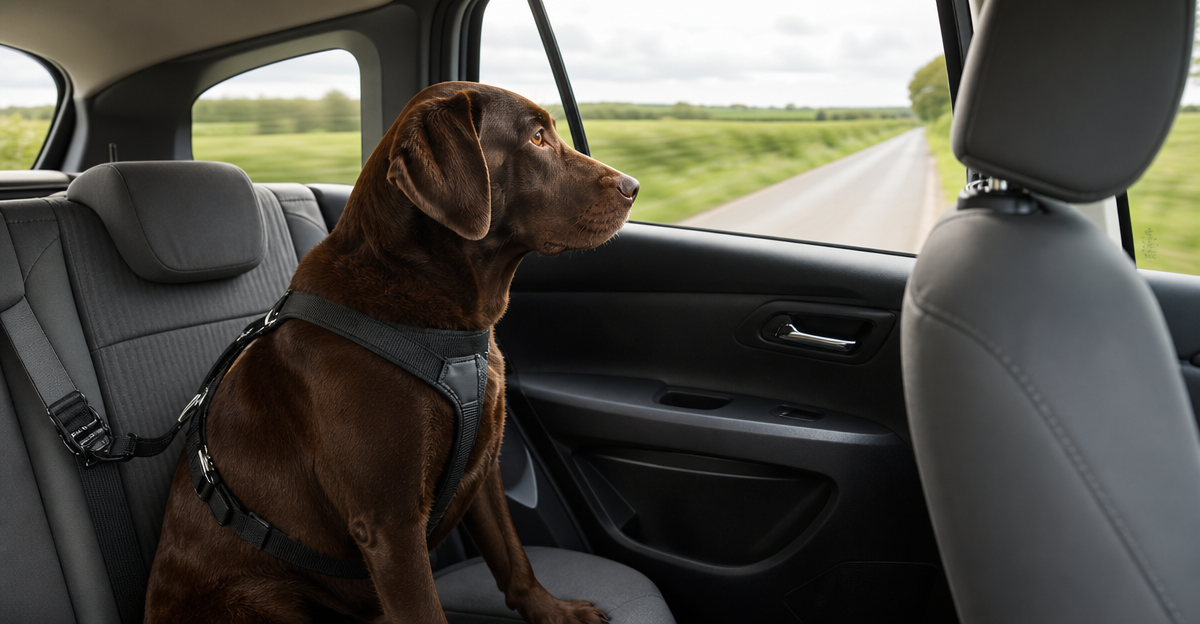
Yes, you can drive with your dog in the UK, but there are rules, and more risk than most owners realise. Highway Code Rule 57 requires dogs to be suitably restrained in a vehicle, and getting it wrong can mean more than a telling-off: it can void your insurance and expose you to a careless driving charge.
Here is everything you need to know about driving with dogs, including a few things most guides get wrong.
Key Takeaways
- If you are travelling with your dog in the UK and need overnight boarding at either end of your journey, Tailstays lists pet hotels across the country, from city-centre options near major transport hubs to rural stays suited to longer trips.
- Highway Code Rule 57 requires your dog to be suitably restrained while travelling. A harness, crate, carrier and dog guard are all recognised methods, but none is mandated above another.
- There is no standalone fixed penalty notice for an unrestrained dog. The legal risk comes via careless or dangerous driving charges under the Road Traffic Act 1988, which can mean fines of up to £5,000 and nine penalty points.
- An unrestrained dog that contributes to an accident can give your insurer grounds to void your claim entirely.
- A dog guard alone does not constitute full restraint. It only prevents the dog entering the passenger cabin.
- Leaving a dog in a parked car, even briefly and even on a mild day, can constitute an offence under the Animal Welfare Act 2006 in England and Wales.
- Motion sickness and car anxiety are different problems with different solutions, including vet-prescribed medication for motion sickness that most guides never mention.
Finding Pet Hotels Near Your Route or Destination
If your journey is too long for your dog to travel comfortably, or if you need somewhere to leave them while you are away, the availability of pet hotels varies considerably depending on where in the UK you are travelling.
In and around major cities such as London, Manchester, Birmingham and Edinburgh, there is usually a good spread of pet hotels, doggy day-care facilities and professional boarding services. Rural areas and smaller towns tend to have fewer options, and those that exist book up quickly during school holidays and bank holiday weekends.
If you are travelling to or from a coastal or countryside destination in summer, plan boarding well in advance. Peak weeks in popular holiday regions such as the Lake District, Cornwall and the Scottish Highlands see local pet hotels fill up fast, and last-minute availability is rare. Equally, if you are flying from a major airport, pet hotels near Heathrow, Gatwick, Manchester and Edinburgh airports are consistently in high demand.
Browse pet hotels by location on Tailstays to check what is available along your route before you commit to travel plans.
Seasonal and Local Factors to Plan Around
Where you are in the UK, and when, shapes both how you travel with your dog and what boarding options are realistic.
Summer (June to August): The most challenging season for dog travel by car. Cars heat up faster than most people expect, and even a 22°C day can produce dangerous interior temperatures within minutes. If you are heading to a popular holiday destination, expect heavier traffic, longer journey times and reduced pet hotel availability at your destination.
Bank holidays and school holidays: Pet hotels in most regions fill quickly around Easter, half-terms and the August bank holiday. If your travel coincides with these periods, booking boarding several weeks in advance is not overcautious. It is necessary.
Winter: Cold weather brings its own risks. A parked car in winter acts like a refrigerator, and dogs left inside risk hypothermia even on mildly cold days. Longer, darker days also mean more travel in poor visibility, another reason proper restraint matters.
Rural vs urban journeys: On long rural routes, service stations with proper dog-walking areas can be sparse. Planning your stops in advance, particularly on motorways in Wales, Scotland or the north of England, is worth doing before you set off rather than hoping for the best at the roadside. Our guide to the best dog holiday destinations in the UK is a useful companion if you are still deciding where to head.
Is It Actually Illegal to Drive With an Unrestrained Dog in the UK?
Rule 57 of the Highway Code states that when in a vehicle, dogs must be suitably restrained so they cannot distract the driver or injure themselves or others in a sudden stop. It does not prescribe a specific method: a harness, crate, carrier or dog guard can all satisfy the requirement depending on the situation.
Here is where many guides mislead you. There is no specific fixed penalty notice for having a loose dog in a car. The legal exposure comes via the Road Traffic Act 1988: if your dog distracts you and you drive carelessly or dangerously as a result, you can face a fine of up to £5,000 and nine penalty points on your licence. That is a very different proposition to a parking ticket, and worth understanding clearly.
The insurance angle is arguably just as serious. If an unrestrained dog contributed to an accident, your insurer can refuse to pay out, leaving you personally liable for damage, injury claims and repair costs. Always check your policy wording. This is not a theoretical risk; it is a standard exclusion clause many drivers never think to read. If you want a broader picture of what cover exists, our overview of pet travel insurance in the UK goes into more detail.
One scenario demands specific attention: leaving a dog in a parked car in warm or cold weather. Under the Animal Welfare Act 2006, causing unnecessary suffering to an animal is a criminal offence in England and Wales. A dog left in a dangerously hot or cold vehicle falls squarely within this, regardless of how briefly you intended to be away.
The Four Main Restraint Options: Which Is Right for Your Dog?
Seatbelt harness
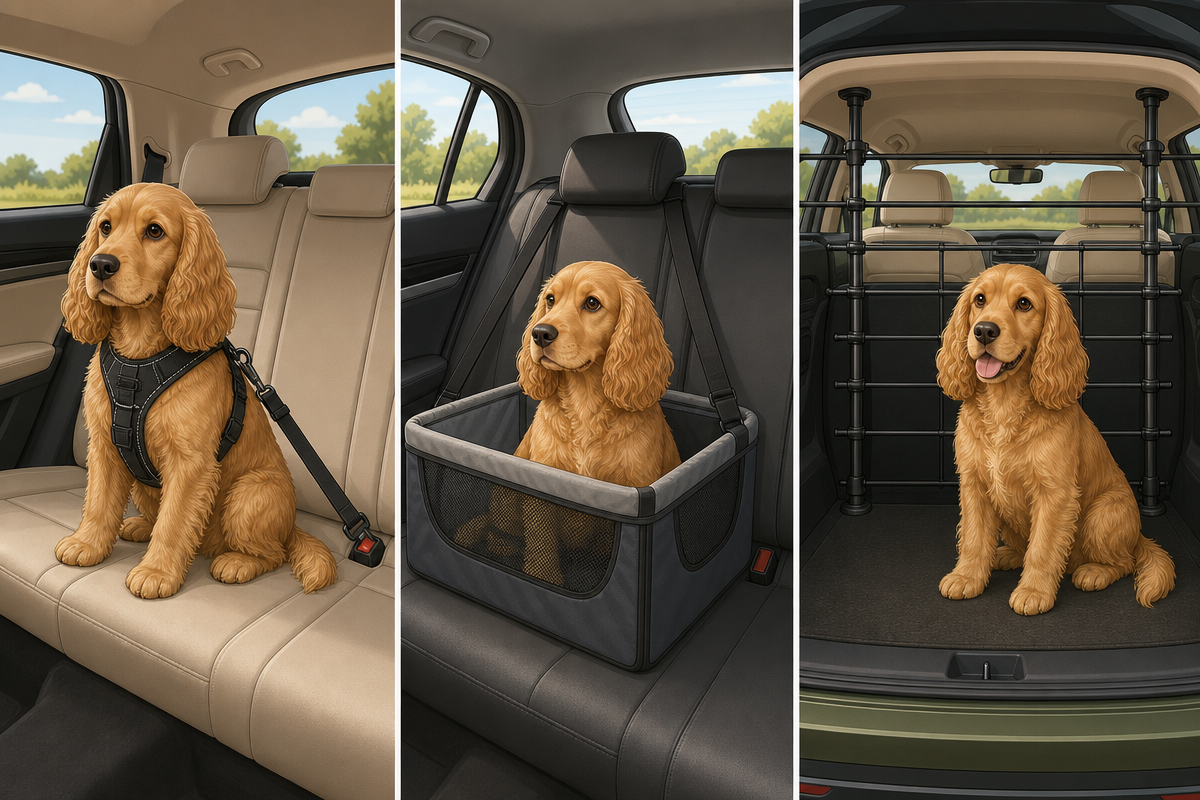
A harness that clips into the seatbelt buckle is the most common choice for dogs travelling on the back seat. It allows your dog to sit or lie down with some movement while keeping them secured. The critical caveat: not all harnesses marketed as safety products have been crash-tested. Research by the Centre for Pet Safety found that many popular harnesses failed crash-test simulations entirely, breaking apart or allowing the dog to travel forward with significant force. If you are buying a harness specifically for safety, look for independently crash-tested models rather than relying on the packaging alone.
Hard crate or soft carrier
For smaller dogs especially, a well-secured crate or carrier is widely regarded as the safest option. The crate must itself be secured so it cannot slide or tip on braking: an unsecured crate becomes a projectile in a collision. Hard-sided crates offer more protection than soft carriers in a serious impact.
Dog guard
A dog guard sits between the boot and the passenger area, preventing the dog from entering the cabin in an emergency stop. It does not restrain the dog within the boot itself. For a large dog travelling in the boot, a guard is a sensible addition, but it is not a standalone restraint solution and should not be treated as one. For genuine compliance with Rule 57, a crate or harness within the boot area is advisable alongside it.
Car boot with liner or hammock
Popular with owners of large breeds, a boot liner or hammock keeps the car clean and gives your dog space to settle. Pair this with a dog guard as a minimum. It is practical and easy to clean after muddy walks, which is exactly why many owners of larger breeds favour the boot.
| Restraint type | Best for | Pros | Cons | Approximate cost |
|---|---|---|---|---|
| Seatbelt harness | Small to medium dogs | Easy to fit, familiar for the dog, widely available | Many are not crash-tested; quality varies widely | £15 to £80+ (crash-tested models at the higher end) |
| Hard crate | Small to medium dogs | Best crash protection; contains the dog fully | Bulky; crate itself must be secured | £40 to £200+ |
| Soft carrier | Very small dogs | Lightweight; easy to carry | Less crash protection than hard crate | £20 to £80 |
| Dog guard | Large dogs in boot | Keeps cabin clear; easy to install | Does not restrain the dog; not sufficient alone | £30 to £150 |
| Boot liner/hammock | Large breeds | Protects upholstery; practical after muddy walks | Needs dog guard alongside; no crash protection | £20 to £100 |
Cost ranges based on market research. Tailstays has no pricing data of its own.
Where Should Your Dog Sit? Front Seat, Back Seat or Boot?
The back seat or boot are the right answers for almost every dog. Here is why the front seat is genuinely dangerous, not just inconvenient.
Passenger airbags deploy at speeds of up to 200mph in a collision. For a human adult sitting upright, the airbag is designed to cushion impact at that angle and distance. For a dog sitting in the passenger footwell, on the seat, or restrained at a different height, the deployment can be fatal. This risk is almost entirely absent from most driving-with-dogs guides, but it is serious and worth knowing. If your dog must travel in the front, disable the passenger airbag, though not all cars allow this.
The back seat is the most common choice for dog owners. A crash-tested harness or a properly secured carrier works well here. A seat hammock keeps the upholstery intact and stops the dog slipping into the footwell.
The boot suits large breeds well, particularly with a liner and dog guard. Despite the practicality of other seating options, a notable proportion of British drivers still allow their dog to travel in the front passenger seat. Given the airbag risk, that is a genuinely concerning habit.
Helping an Anxious Dog Cope With Car Travel
Recognising signs of car anxiety
Panting, drooling, whining, yawning repeatedly, trembling or flatly refusing to get into the car are all signs your dog is not comfortable. This is far from rare among dogs. Recognising the signs early matters, because the longer anxiety goes unaddressed, the more entrenched it tends to become. If you want to get better at reading these signals generally, our guide to dog body language is a good place to start.
Motion sickness vs anxiety: they are not the same
This distinction matters, because the solutions differ. Motion sickness is physiological: it is caused by the inner ear detecting movement that the eyes are not confirming, which triggers nausea. Anxiety is behavioural: it is an emotional response, often linked to a negative association with the car. A dog can have one, the other, or both.
For motion sickness, the practical steps are: withhold food for 2 to 3 hours before travel (not vaguely "just before", as the window matters), keep the car cool and well-ventilated, and position the dog facing forward so visual cues match the sensation of movement. If these measures do not help, speak to your vet. Prescription anti-nausea medication is available for dogs and works well, yet almost no driving-with-dogs guide mentions it. Your vet can also advise on whether what you are seeing is sickness, anxiety or a combination.
Gradual desensitisation for anxious dogs
For genuine anxiety, a gradual approach works better than forcing the issue. Start by simply sitting in the stationary car with your dog, treating and praising calmly. Progress to turning the engine on without moving. Then try a one-minute drive around the block. Build duration gradually, always ending on a positive note before the dog reaches its stress threshold.
Familiar scents help, so bring their bed or a worn item of your clothing. Calming aids such as Adaptil (a synthetic pheromone) or Zylkene (a natural supplement) are worth discussing with your vet if anxiety is persistent. For dogs with severe travel anxiety, a referral to a certified clinical animal behaviourist is a reasonable next step.
Practical Tips for UK Dog Owners Travelling by Car
- Book pet hotels before you book travel. If your journey requires an overnight stay or you need boarding at your destination, check availability first. Pet hotels in popular areas fill up well ahead of peak periods, and availability shapes your options more than most owners expect.
- Know your service station options. On major motorways, services vary considerably in how dog-friendly they are. Some have dedicated walking areas; others offer little beyond a verge beside the car park. Apps and route-planning tools that flag dog-friendly stops are worth using before a long drive.
- Keep a travel kit in the car. A non-spill water bowl, a spare lead, poo bags, a basic first-aid kit and any regular medication should travel with your dog as standard. If you drive regularly with your dog, keeping these in the car permanently saves the last-minute scramble.
- Check your insurance policy wording now, not after an incident. Most drivers have never read the clause relating to animal restraint. It takes a few minutes and removes any ambiguity about your cover.
- In summer, plan your journey timing around temperature. Early morning and evening travel is considerably safer and more comfortable for your dog than midday in warm weather. If you cannot avoid daytime travel, factor in more frequent stops and ensure you have enough water.
- If your dog struggles with long journeys, boarding is a practical alternative. Not every dog is suited to hours in a car, and not every trip is dog-appropriate. Finding a good local pet hotel near your home means your dog stays comfortable while you travel. Find pet hotels near you on Tailstays to see what is available in your area.
Planning a Long Journey With Your Dog
Every two hours is the guideline for stopping on a long drive with a dog. Use each break to offer water, let them toilet and stretch their legs briefly. Keep them on a lead at motorway service stations, as the environment is busy and unfamiliar. And never leave your dog in the car while you go inside, even for a few minutes; see the guidance below on parked cars. Come back to the car to check on them, or take them with you if the service station has outdoor areas.
Not all service stations are equal for dogs. Some have dedicated dog walking areas; others have little more than a strip of grass near the car park. Planning your route in advance, checking which services have proper dog areas, takes minutes and makes a real difference on a long trip.
Pack a non-spill water bowl and enough water for the journey. Bring familiar bedding or a favourite toy to help your dog settle. Include any regular medication, poo bags and a basic pet first-aid kit. As noted in the motion sickness section, feed your dog 2 to 3 hours before you leave, not immediately before departure.
Temperature management deserves particular attention. Cars heat up faster than most people expect: the RSPCA notes that on a 22°C day, a car interior can reach dangerous temperatures within minutes. Cracked windows are not sufficient ventilation. If you are making a long journey in summer, plan stops carefully and never rely on a partially open window to keep a dog safe.
If the journey is genuinely too long for your dog to travel comfortably, or if you are travelling somewhere your dog cannot come, a pet hotel stay is worth considering rather than putting your dog through hours of stress. Tailstays lets you search and compare pet hotels across the UK, so you can find a good option near your home or destination before you travel.
What You Must Never Do When Driving With a Dog
Never leave a dog in a parked car
The RSPCA warns that a dog can begin to suffer heatstroke within 15 minutes in a hot car. But cold weather is equally overlooked: a car in winter acts like a refrigerator, and a dog left inside for any length of time risks hypothermia. Neither scenario requires extreme weather to become dangerous, as mild days and cool evenings are sufficient. Under the Animal Welfare Act 2006, causing unnecessary suffering to an animal is a criminal offence in England and Wales, and a dog left in a dangerously hot or cold vehicle falls squarely within this.
Never let your dog hang its head out of the window
Debris, insects and grit travelling at speed can cause serious eye and ear injuries. There is also a real risk of the dog falling out, particularly on bends or if you brake sharply. And practically speaking, a dog with its head out of a window is by definition not restrained, which puts you in direct conflict with Rule 57. Some guides describe this as "not necessarily illegal", but that framing misses the point entirely.
Never let a dog sit on the driver's lap
This obstructs the steering, blocks mirror sightlines and creates a direct physical distraction. It constitutes careless driving and, if it contributes to an incident, will give your insurer grounds to refuse a claim as well.
Never feed immediately before travel
A full stomach significantly increases the risk of motion sickness. As covered in the motion sickness section, feed your dog 2 to 3 hours before you set off. This is a specific window, not a vague guideline.
Never allow your dog to distract you
At 70mph, a vehicle travels roughly 31 metres every second. A momentary distraction, whether turning to check on your dog, reaching back to calm them or letting them climb onto the centre console, is enough to cause a serious accident. Proper restraint is not just about your dog's safety. It is about yours and everyone else on the road.
Frequently Asked Questions
Can I be fined for having a loose dog in my car?
Not through a specific fixed penalty notice for an unrestrained dog, as no such penalty exists in isolation. However, if your dog distracts you and you drive carelessly or dangerously as a result, you can be charged under the Road Traffic Act 1988 and face a fine of up to £5,000 with up to nine penalty points. That is a considerably more serious consequence than a straightforward fine, and it is worth understanding the distinction.
Does my car insurance cover accidents if my dog was unrestrained?
Not necessarily. Insurers can refuse to pay out if an unrestrained dog contributed to the accident. This applies even if you were not otherwise at fault. Check your policy terms before travelling, and do not assume cover extends to incidents caused by an unsecured pet.
Is a dog guard enough to legally restrain my dog?
A dog guard alone does not restrain the dog. It only prevents them from entering the passenger cabin. For full compliance with Rule 57, a crate or secured harness within the boot is advisable alongside the guard, particularly for larger dogs.
Can a dog travel in the front seat?
Technically yes, if restrained, but it is strongly inadvisable. Passenger airbags deploy at extremely high speed and at an angle designed for adult humans, not dogs. The deployment can be fatal to a dog in the passenger seat or footwell. If there is no practical alternative, disable the passenger airbag if your car allows it.
What if my dog gets car sick?
Withhold food for 2 to 3 hours before travel, keep the car cool and well-ventilated, and position your dog so they are facing forward. If sickness persists despite these measures, speak to your vet, as prescription anti-nausea medication is available for dogs and is effective. Do not assume it is something your dog simply has to tolerate.
How often should I stop on a long drive with my dog?
Every two hours is the general guideline. Use each stop to offer water, allow your dog to toilet and have a short walk. Never leave your dog in the car while you take a break inside a service station, even for a few minutes.