
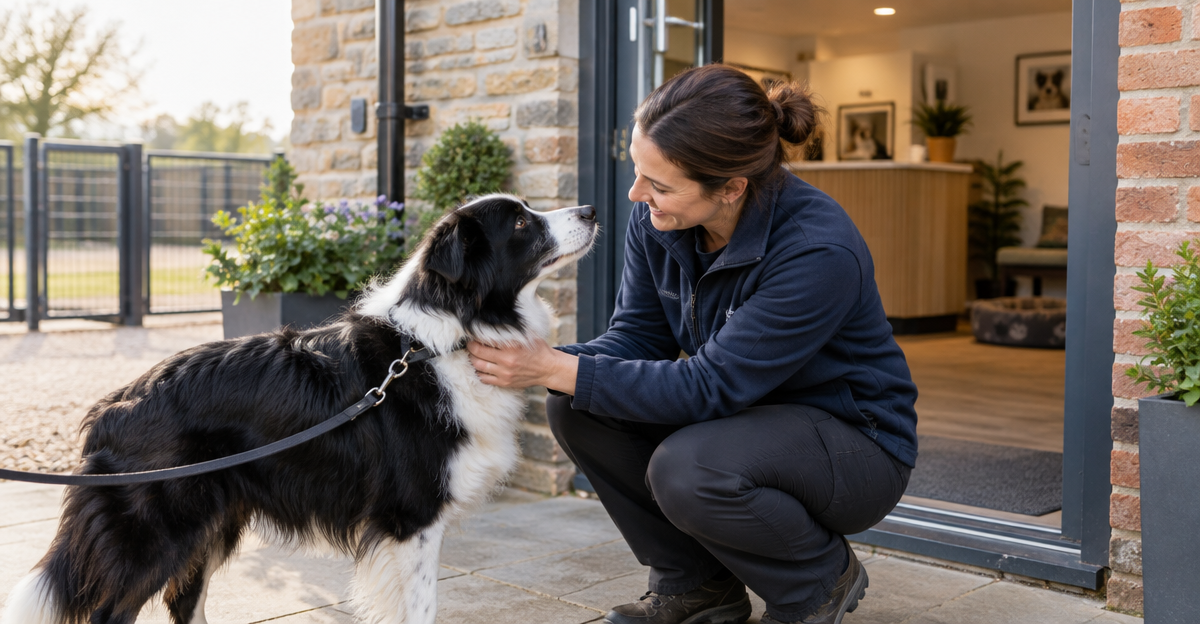
Finding the Right Dog Kennels in Manchester
Greater Manchester has a wide range of dog boarding options, from traditional kennels on the city's outskirts to licensed home boarders operating in residential areas across all ten boroughs. The challenge isn't finding somewhere. It's knowing how to tell a good option from a risky one.
This guide covers what Manchester dog owners actually need to know about dog kennels in Manchester: the types of boarding available, what the law requires, how much to budget, and what to look for when you visit.
Key Takeaways
- Greater Manchester spans ten boroughs. Traditional kennels tend to be on the outskirts, while home boarders are distributed across the region.
- Both kennels and home boarders must hold a licence from their local council under the Animal Welfare (Licensing of Activities Involving Animals) (England) Regulations 2018. Always ask for the licence number.
- Prices vary by size and type. Moss Cottage Boarding Kennels in Sale lists kennel rates from £25/day (small dogs), £27/day (medium dogs) and £30/day (large dogs). Home boarding rates in Manchester typically range from around £20 to £50+ per night.
- Most kennels require the kennel cough vaccine. Timing before arrival depends on which vaccine type your dog receives, so confirm with both your vet and the kennel. See the Vaccinations section for what to ask.
- Peak periods (Easter, summer school holidays, Christmas and Manchester's busy events calendar) fill up fast. For August and December, book two to three months ahead.
- Star ratings (1 to 5) are issued by local councils and reflect the outcomes of welfare inspections. A higher rating can also extend the licence period.
What Dog Boarding Options Are Available in Manchester?
Greater Manchester is not just the city centre. It covers ten boroughs including Salford, Trafford, Stockport, Oldham, Tameside, Wigan, Bolton, Bury and Rochdale. Your location within that footprint shapes which options are practical for you.
The three main types
Traditional boarding kennels are purpose-built facilities, usually on the semi-rural outskirts of the conurbation. You'll find several in the Sale and Wythenshawe corridor (convenient for Manchester Airport), around Chadderton and Oldham to the northeast, and along the Stockport and Tameside edges of the region. Dogs stay in individual kennels or suites, with structured exercise routines and on-site staffing throughout the day.
Home boarding means your dog stays in a carer's private home alongside the family. It tends to suit dogs that struggle with the kennel environment, particularly anxious dogs, those used to constant human company, or older dogs who find change stressful. Home boarders typically take fewer dogs at once, which can mean more individual attention. If you're weighing the two up in detail, our guide on home boarding vs kennels goes deeper into the trade-offs.
Pet hotels sit somewhere between the two: commercial facilities designed to feel less institutional than a traditional kennel, often with more flexible sleeping arrangements and additional services like grooming or daycare.
Geography matters more than you might think
If you're flying from Manchester Airport, kennels near Junction 8 of the M60 (such as Moss Cottage in Sale) are worth prioritising. The journey from the terminal is straightforward and short, which is useful when you're already lugging holiday bags. That said, the M60 and M62 can be slow during rush hour, so a kennel that looks five miles away on the map might take considerably longer to reach at peak times.
For owners in the north of Greater Manchester (Rochdale, Bury, Bolton), it's worth searching your own borough rather than defaulting to city-centre proximity. The region is large enough that crossing it adds significant journey time.
Tailstays lists pet boarding options across the UK, including in the northwest. Liverpool, for example, has 17 listings in our directory. Supply varies considerably by borough across Greater Manchester, so it's worth using the search to filter by area rather than treating the region as a single pool.
Search dog boarding options across Greater Manchester on Tailstays
Traditional Kennels vs Home Boarding: Which Suits Your Dog?
Both are regulated, and both can be excellent. The right choice depends on your dog's personality and needs, not on which type sounds more appealing in principle.

| Factor | Traditional Kennels | Home Boarding |
|---|---|---|
| Environment | Purpose-built facility, individual kennels or suites | Domestic home setting, shared living space |
| Supervision | Staff on-site during the day; overnight arrangements vary | Usually with the carer around the clock |
| Other dogs | Multiple dogs on site, usually kept separate | Typically fewer dogs; some take just one guest at a time |
| Socialisation | Can be good for confident, sociable dogs | Better for dogs that don't enjoy kennel noise or proximity |
| Regulation | Licensed under 2018 Regulations; star-rated by local council | Also licensed under 2018 Regulations; star-rated by local council |
| Best for | High-energy dogs, dogs that are comfortable with structure | Anxious dogs, senior dogs, dogs on regular medication |
One point worth flagging clearly: home boarding in England is not unregulated. Anyone who boards dogs in their home for payment must hold a licence from their local council under the Animal Welfare (Licensing of Activities Involving Animals) (England) Regulations 2018, the same legal framework that governs kennels. An unlicensed home boarder is operating illegally, regardless of how warm and caring their profile looks online.
Some home boarders advertise membership of trade associations such as Dog Care Professionals UK as a trust signal. Membership of a trade body is not the same as holding a statutory licence. The two can coexist, but the licence is the legal requirement. Always ask for the licence number first.
For dogs on regular medication, home boarding can be more practical, since a carer with one or two dogs can manage administration more easily than a busy kennel. That said, several licensed kennels do administer medication; see the section below on what to ask when visiting. If your dog gets particularly unsettled when you're away, our piece on separation anxiety and dog boarding is worth a read before you decide.
How Much Do Dog Kennels in Manchester Cost?
Kennel pricing in Greater Manchester varies by dog size, facility type and time of year. Moss Cottage Boarding Kennels in Sale lists its rates (inclusive of VAT) at approximately £25/day for small dogs, £27/day for medium dogs and £30/day for large dogs (at time of writing; confirm current rates directly with the facility). Not all kennels are VAT-registered, so when comparing quotes, check whether VAT is included. The difference can be meaningful over a longer stay.
Home boarding tends to offer a wider price range. Rates in Manchester typically start from around £20/night and can reach £50/night or more depending on the sitter's experience, location and the level of care involved.
Extra costs to budget for
The headline daily rate is rarely the full picture. A few things to factor in:
- Bank holiday surcharges. Moss Cottage charges an additional £10 to £15 per public holiday. This is common practice across boarding facilities, so a stay spanning Easter weekend, for example, will cost noticeably more than the same number of days mid-April.
- Deposits. Many kennels take a non-refundable deposit to secure a booking, particularly at peak times. Expect £50 to £100 depending on the facility and length of stay.
- Medication administration fees. Some kennels charge per administration; around £2 per dose is not unusual. If your dog takes multiple medications daily, ask about this upfront.
- Specialist diet surcharges. If your dog requires a specific food that the kennel doesn't stock, there may be a handling fee or you'll need to provide your own supply.
- Discounts for longer stays. Some kennels offer a reduced daily rate for stays over a certain length. Moss Cottage mentions this for stays of 12 days or more.
Peak periods to watch are Easter, June through August, and the Christmas and New Year stretch. Manchester's events calendar adds extra pressure: major music festivals, football fixtures and school half-terms all drive demand. During these windows, popular options can be fully booked weeks in advance.
What the Law Requires: Licensing and Welfare Standards
In England, any business or individual that boards dogs for payment (whether in a kennel or in their home) must hold a licence issued by their local council under the Animal Welfare (Licensing of Activities Involving Animals) (England) Regulations 2018. That means every kennel and home boarder across Greater Manchester's ten boroughs falls under this framework, with each borough's council acting as the licensing authority.
For example, a kennel in Chadderton would be licensed by Oldham Council, one in Sale by Trafford Council, and one in Stockport by Stockport Council. Each council inspects facilities in its area and issues a star rating from 1 to 5. Our overview of UK dog boarding regulations explains how these rules protect your pet in more detail.
What the star ratings mean
The star rating reflects the outcome of the council's inspection. It covers welfare standards, risk management procedures, record-keeping and the physical environment. A higher rating means the facility demonstrated better outcomes across these areas, not just that it looks nicer.
There's a practical benefit to a high rating beyond the welfare signal: facilities rated 4 or 5 stars may receive a licence valid for up to three years, while lower-rated facilities may be inspected more frequently. That means a 5-star facility has consistently met a higher bar across multiple inspection cycles.
To find a kennel's rating, you can ask the operator directly; they should be able to tell you immediately. You can also check via the issuing council's licensing register. If an operator can't tell you their star rating or licence number, treat that as a red flag.
What the licence covers
The 2018 Regulations set out requirements covering exercise provision, space standards, hygiene protocols, temperature management and record-keeping. The licence holder must also demonstrate competence to run the operation, though the regulations do not mandate a specific qualification level for staff. What matters legally is that the person responsible can show they know what they're doing.
DBS checks for home boarders are not a requirement under the 2018 Regulations, but some operators obtain one voluntarily as a reassurance to clients. It's worth asking, particularly for home boarding where your dog will be in a private residence.
Find licensed dog boarding options near you on Tailstays
What to Look for When Visiting a Manchester Kennel or Boarder
Any reputable provider will welcome a visit before you commit. Use it. Here's what to cover:
- Ask for the licence number and the issuing council. This is non-negotiable. The operator should be able to provide both immediately.
- Check the star rating. Ask how many stars the facility holds and when it was last inspected.
- Vaccination requirements. Ask exactly what they need and by when (more on this in the next section).
- Exercise routines. How many times a day is your dog exercised? For how long? Is there covered or indoor space for wet weather? Given Manchester's climate, this matters for longer stays.
- Medication handling. If your dog takes regular medication, ask about the process: how it's administered, whether there's a fee per dose, whether they need a vet's written authorisation, and how they'd respond to a reaction or missed dose.
- Updates during the stay. Do they send photos or videos? Is there CCTV? Some facilities operate 24-hour CCTV as standard; Moss Cottage does, for example.
- Staffing levels. Ask about the maximum number of dogs on site at any one time and how many staff are present. This matters most overnight.
- What to bring, and what not to. Some kennels ask you not to bring bedding or toys from home to prevent cross-contamination between animals. Moss Cottage specifically requests this, providing sanitised bedding and equipment instead (at time of writing; policies can change, so confirm when you visit). Don't assume bringing your dog's familiar blanket is always welcome. Check first, and our guide to what to pack for dog boarding covers the essentials.
- Cancellation and deposit policy. Get this in writing before you pay anything. Non-refundable deposits are common; cancellation windows vary.
- Peak-period surcharges. Ask upfront about bank holiday and public holiday charges so there are no surprises on the final invoice.
Vaccination Requirements for Dog Kennels in Manchester
Almost every licensed kennel in Greater Manchester requires up-to-date core vaccinations, typically covering distemper, parvovirus and infectious hepatitis. If your dog's boosters have lapsed, most kennels will not accept them until they're current again, so check your vaccination record well before your intended booking date.
The one that catches owners out most often is the kennel cough vaccine. The majority of kennels require it, and the critical detail is that how far in advance it needs to be given depends on the type of vaccine. Intranasal kennel cough vaccines can be effective in as little as 72 hours, while injectable versions typically need around two weeks to take effect. Many kennels set their own minimum lead time (commonly around 14 days as a blanket policy), but this is not a universal rule that applies to every vaccine type or every facility. The right approach is to confirm the timing requirement with both your vet (who can tell you which vaccine your dog is receiving) and the kennel (which will tell you what it specifically requires). Don't assume the same window applies everywhere. And don't leave it to the week before drop-off: if your dog's vaccination timing doesn't meet the kennel's policy, they may turn your dog away. Our guide on kennel cough before boarding explains the vaccine types in more depth.
On microchipping: this has been a legal requirement for all dogs in England since 2016. Most kennels will check. If your dog isn't microchipped, Moss Cottage offers the service on arrival (confirm the current charge directly with the facility), but it's far better to sort this before you go.
Some facilities now ask for vaccination records to be uploaded digitally before confirming a booking. If the kennel you're considering offers this, use it. It removes one more thing to remember on drop-off day.
Local Factors Worth Knowing Before You Book
A few things specific to boarding in Greater Manchester that don't always come up in generic guides:
Manchester Airport proximity. Kennels near Junction 8 of the M60 (the Sale and Wythenshawe corridor) are genuinely convenient for pre-holiday drop-off. The drive from the airport is short and doesn't require crossing the city. These options fill up quickly during school holiday periods, so if you're travelling in August or over Christmas, book as early as you can.
The M60 effect. Greater Manchester's orbital motorway connects the boroughs, but peak-hour congestion can make short distances feel long. A kennel in Stockport might be geographically close to your home in Salford, but the journey in morning traffic is a different matter. Check the actual travel time before committing to a facility at the far side of the ring road.
Manchester's events calendar. School holidays are the obvious pressure point, but Manchester's packed events schedule creates additional surges in demand. Major concerts at the Co-op Live arena, football fixture weekends at Old Trafford and the Etihad, and festivals across the summer all push more owners to book boarding simultaneously. This is not a problem if you plan ahead, but it catches people out.
The weather. Manchester is one of the wetter cities in England. For stays of more than a few days, it's worth asking whether the kennel has covered exercise areas or indoor enrichment options. A dog that's cooped up due to persistent rain for a week is not a happy dog, and you shouldn't have to pay peak rates for that experience.
Frequently Asked Questions
Do home boarders in Manchester need a licence?
Yes. Under the Animal Welfare (Licensing of Activities Involving Animals) (England) Regulations 2018, anyone in England who boards dogs in their home for payment must hold a licence from their local council. This applies across all ten boroughs of Greater Manchester. Always ask for the licence number and the name of the council that issued it before you book.
How far in advance should I book dog kennels in Manchester?
For peak periods (Easter, the summer school holidays, and Christmas through to New Year), booking two to three months ahead is advisable. Popular kennels near Manchester Airport in particular can be fully committed for August before June arrives. For off-peak periods, a few weeks' notice is usually sufficient, but earlier is always safer.
Can I board a dog that hasn't had the kennel cough vaccine?
Most licensed kennels in Manchester require it. How far in advance it needs to be given depends on the vaccine type: intranasal versions can be effective in as little as 72 hours, while injectable versions typically need around two weeks. Many kennels apply a blanket minimum (often around 14 days) regardless of vaccine type, but policies vary. Confirm the specific requirement with both your vet and the kennel before you book, and don't leave it to the last minute.
What's the difference between a 3-star and 5-star kennel licence?
The star rating is awarded by the local council following an inspection of the facility. It reflects outcomes across welfare standards, risk management and record-keeping, not simply how smart the facility looks. A higher rating indicates the kennel has performed better across those areas. There's also a practical difference: a 5-star facility may receive a licence valid for up to three years, while a lower-rated facility may be inspected more frequently. Higher ratings represent a more sustained track record, not just a snapshot.
Are dog kennels in Manchester open over Christmas?
Some are. Moss Cottage, for example, operates 365 days a year but with restricted hours on Christmas Eve and New Year's Eve (9am to 12pm for drop-off and collection), and no drop-off or collection on Christmas Day, Boxing Day or New Year's Day. A bank holiday surcharge applies. Not all kennels follow the same schedule, so always confirm opening hours and holiday policies directly with the facility before booking a stay that spans the Christmas period.