
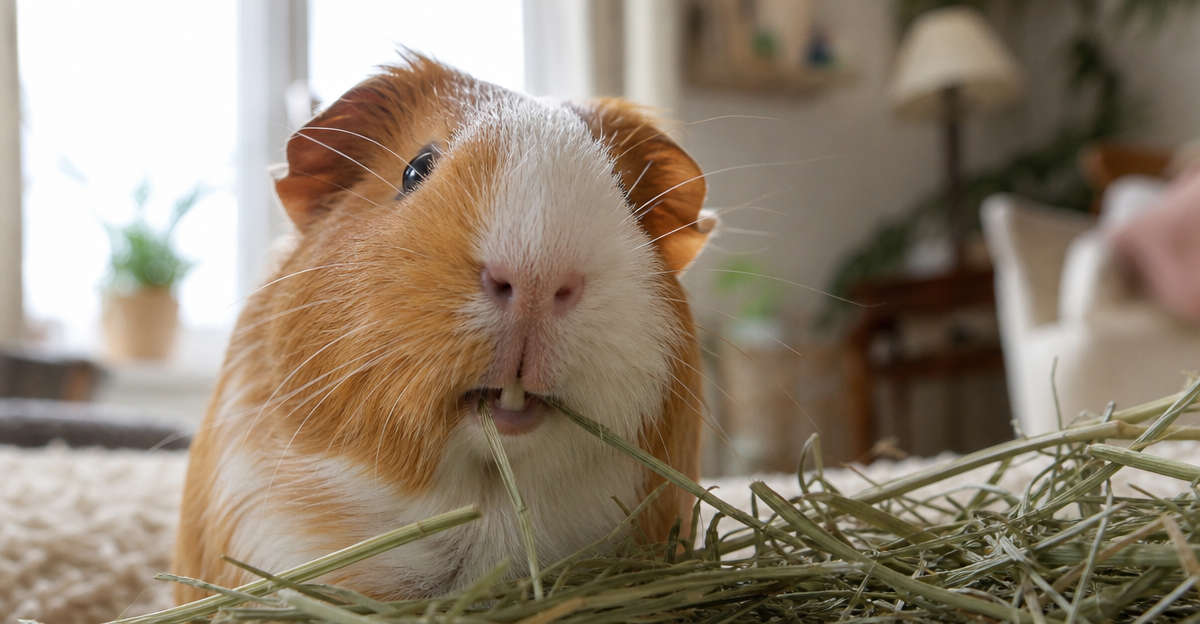
Guinea pig dental care is one of the most important, and most misunderstood, aspects of owning these animals. Their teeth grow continuously throughout life and need constant wear to stay healthy. Get the diet right, know the warning signs, and find the right vet when things go wrong, and you have covered most of what matters.
Key Takeaways
- Guinea pigs have 20 continuously growing teeth that must be worn down through diet, not trimming.
- Hay should make up at least 80% of the diet. It is the single most important factor in dental health.
- Dental disease is one of the most common reasons guinea pigs are seen by exotic vets.
- Guinea pigs hide pain well. By the time symptoms are obvious, disease is often well advanced.
- Vitamin C deficiency can directly cause dental problems, a unique vulnerability among common small pets.
- Home tooth brushing is not recommended, not necessary, and not supported by veterinary guidance.
- Never attempt dental trimming at home with nail clippers or wire cutters. This causes serious injury. See the Treatment Options section for why.
Why Guinea Pig Teeth Are Different From Other Pets
Most owners know guinea pigs have ever-growing teeth. But the way those teeth grow, and the problems that creates, is more complex than it first appears.
Continuously growing teeth
Guinea pig teeth are described as aradicular hypsodont, which sounds technical but simply means they are open-rooted and grow continuously throughout the animal's life. This is true of every tooth in their mouth, not just the front ones. As the WSAVA 2010 proceedings (Steinmetz, University of Zürich) explain, this growth is the guinea pig's adaptation to a diet of tough plant material that would grind down a fixed tooth set within a few years.
The full set: 20 teeth
Guinea pigs have 20 teeth in total. The dental formula is one incisor, no canines, one premolar, and three molars on each side of both the upper and lower jaw. That gives you four incisors at the front, and 16 cheek teeth (premolars and molars) further back. The cheek teeth are where most dental disease actually happens.
The anatomy that makes cheek teeth so problematic
This is where guinea pigs differ significantly from rabbits, and from almost every other pet you might compare them to. According to the WSAVA 2010 and JAVMA 2015 (Capello) literature, guinea pig cheek teeth meet at an oblique angle of roughly 30 degrees rather than horizontally. Each upper cheek tooth has only a single lower cheek tooth to wear against. The result is a bite surface that is structurally prone to developing sharp spurs and uneven wear, especially when diet is inadequate.
Rabbits have a similar tooth type but a more favourable occlusal angle. Guinea pigs got a harder deal anatomically, and diet has to compensate for it.
One important point: the incisors at the front are the only teeth you can see when you look at your guinea pig at home. The cheek teeth are completely hidden from view without specialist equipment. This distinction matters a great deal when it comes to spotting problems, and is covered in more detail in the diagnosis section below.
What Healthy Guinea Pig Teeth Should Look Like
Knowing what normal looks like helps you notice when something has changed.
Incisors
Healthy incisors are curved and chisel-shaped. The lower incisors are slightly longer than the upper ones. This is completely normal and differs from rabbits, where the pairs are roughly equal in length. The surface should be smooth and symmetrical, without obvious chips, crossing, or spiralling.
A quick word on colour, because it trips people up. Some sources, including the popular guinea pig care site GuineaDad, describe healthy incisors as white. That is worth correcting. Slight yellowing or orange tinting of the incisors is normal, particularly in older guinea pigs, and does not indicate disease. If your guinea pig's incisors have always had a faint yellow or orange tinge, there is no need to panic. What warrants attention is a sudden colour change, or colour change alongside other symptoms such as reduced eating or weight loss.
What you cannot see: the cheek teeth
This is the part of guinea pig dental health that consumer guides consistently underplay. You cannot assess cheek teeth at home. You cannot see them, feel them, or meaningfully evaluate them without sedation, specialist equipment, and usually imaging. A guinea pig can have severely diseased cheek teeth while looking perfectly normal to a home observer.
This is not a reason for alarm on its own. It is a reason to keep up with routine vet checks and to act quickly if any behavioural or physical changes appear.
The Role of Diet in Dental Health
Diet is not one factor among several. It is the foundation everything else rests on. Get it wrong and no amount of chew toys or vet visits will keep your guinea pig's teeth healthy long-term.
Hay: the non-negotiable foundation
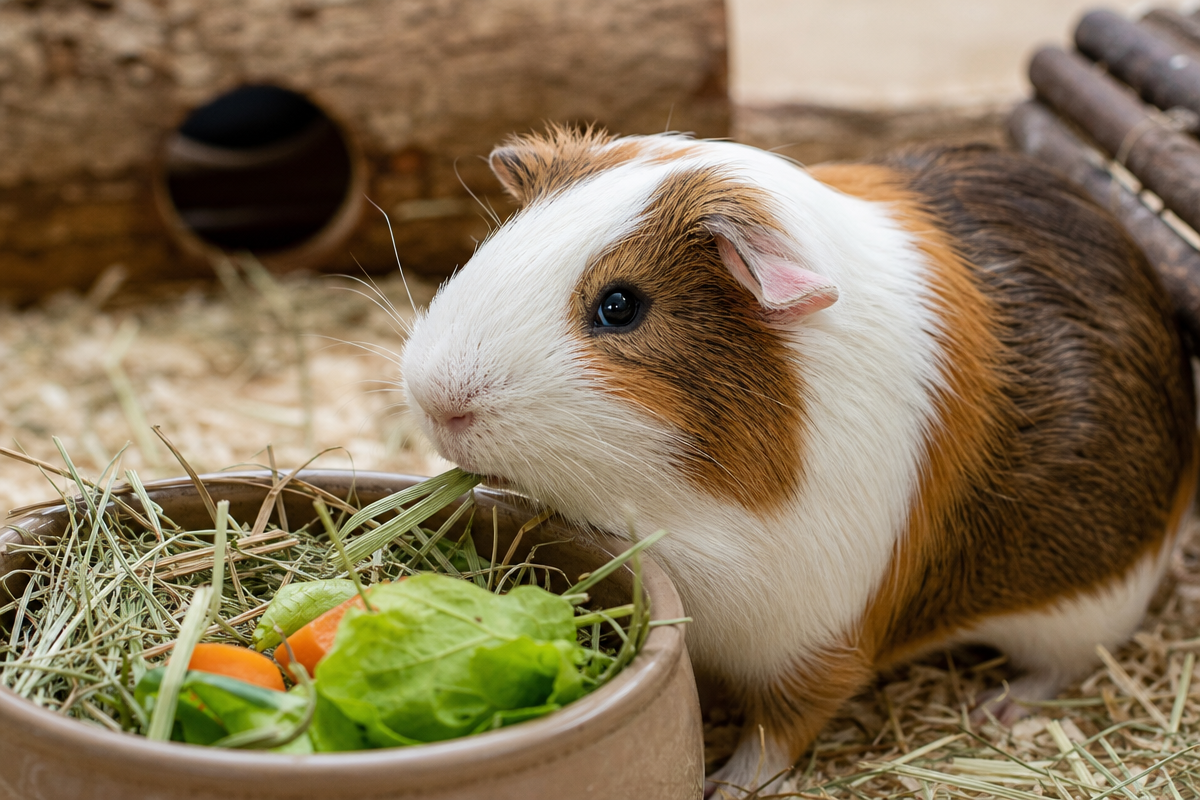
Hay should make up at least 80% of your guinea pig's daily diet. The abrasive silica fibres in hay are what wear the cheek teeth down naturally, maintaining the correct occlusal surface. Without enough hay, cheek teeth overgrow and the cycle of dental disease begins.
Not all hay is equal. The WSAVA 2010 proceedings note that first-cut hay has higher crude fibre content than second-cut hay. Second-cut hay, the softer, greener, more palatable type typically sold in UK pet shops, is less effective at wearing teeth because it requires less chewing force. Timothy hay and meadow hay are both suitable. The key is that it should be coarse enough to require real grinding effort.
Pellet-only diets, or diets based on muesli-style mixed feeds, are a leading cause of dental disease in guinea pigs. This is particularly relevant in the UK, where colourful muesli-style mixes remain widely sold in supermarkets and pet shops. These mixes encourage selective feeding: guinea pigs pick out the tasty bits and leave the higher-fibre components. The result is reduced chewing time, insufficient tooth wear, and over time, malocclusion.
Vitamin C: the guinea pig dental wildcard
Unlike most mammals, guinea pigs cannot synthesise their own vitamin C. This is well known among owners, but what is less understood is the direct link between deficiency and dental disease.
Vitamin C is essential for collagen production and connective tissue integrity. A deficiency weakens the periodontal ligaments that hold teeth in their sockets. Teeth become loose, wear unevenly, and the resulting irregular occlusal surface leads to overgrowth and crown elongation. This is not a theoretical risk. It is a documented pathway to dental disease unique to guinea pigs among the small pets most owners are familiar with.
The practical implication is that fresh leafy greens are your best daily source. Bell peppers (particularly red), kale, parsley, and leafy greens all provide meaningful amounts of vitamin C. Many UK owners supplement via vitamin drops added to water, but vitamin C degrades rapidly when exposed to light and oxygen in a water bottle, often within hours. Food-based supplementation is far more reliable.
What to avoid
- Muesli-style mixed feeds (they encourage selective feeding and reduce fibre intake)
- Soft, low-fibre foods: bread, cooked food, excessive fruit
- Hard nuts or seeds, which can fracture teeth
- Sugary treats in more than very small quantities
Chew toys and wooden items
Safe chew materials, such as untreated fruit wood (apple or pear wood), plain cardboard, and willow, give guinea pigs something to gnaw between meals and provide some enrichment. They are a useful addition to the enclosure. They are not, however, a substitute for hay, and they do not meaningfully address cheek teeth wear in the way hay does.
A note on commercial wooden toys: products marketed specifically as dental health tools for guinea pigs are often presented as an essential part of the care routine. Independent veterinary guidance does not support this framing. Hay does the dental work. Chew toys are enrichment. If you choose to offer them, keep to untreated, unpainted wood from safe species.
Recognising the Signs of Dental Problems
Guinea pigs are prey species. They are hardwired to conceal weakness, which means by the time a dental problem is obvious to you, it has usually been developing for some time. Knowing the early, subtle signs is genuinely important.
Early signs, often missed
- Gradual weight loss or loss of condition
- Quidding: picking up food, chewing briefly, then dropping it
- Preference for softer foods and reluctance to eat hay
- Reduced faecal output, or smaller and misshapen droppings
- Wet or matted fur around the chin or chest, indicating excess drooling
The WSAVA 2010 proceedings identify cheek teeth spurs, sharp points that form on the edges of cheek teeth, as a common early cause of mouth ulcers. Owners rarely detect these because there are no external signs until the animal stops eating or begins drooling. By that point, the spur has usually been causing pain for days or longer.
Later and more serious signs
- Refusing food or complete anorexia
- Facial swelling or a hard lump along the jawline
- Eye discharge or weeping eyes (epiphora), as cheek tooth root elongation can compress the tear duct
- Nasal discharge
- Laboured or noisy breathing
These later signs indicate that disease has progressed significantly. Some of them, particularly anorexia and breathing difficulty, need emergency veterinary attention. A guinea pig that has not eaten for 12 hours or more is at risk of gastrointestinal stasis, which becomes life-threatening quickly.
Why waiting for obvious distress is dangerous
It can be tempting to take a wait-and-see approach when a guinea pig seems slightly off but is still moving and eating a little. With dental disease, this is the wrong instinct. Act on early signs. Your vet cannot undo weeks of progression.
Common Guinea Pig Dental Conditions Explained
Malocclusion
Malocclusion means the teeth are not meeting correctly. It can be congenital (the animal is born with a structural predisposition) or acquired through poor diet, trauma, or metabolic disease. Incisor malocclusion is visible. Cheek teeth malocclusion is not, and it is the more dangerous of the two.
A severe presentation described in the JAVMA literature is tongue entrapment, where the mandibular (lower) cheek teeth grow inward and over the tongue, trapping it. By this stage, the animal cannot eat at all and is in serious pain. It is one of the more distressing outcomes of unmanaged cheek teeth disease.
Dental spurs
Spurs are sharp points or ridges that form on the edges of cheek teeth when they are not being worn evenly. They lacerate the cheek and tongue, causing pain with every mouthful. An animal with spurs will often quid food, picking it up and dropping it, before any external sign of disease is apparent.
Tooth root elongation
Because guinea pig teeth are open-rooted and grow continuously, the roots can elongate downward into the jaw when the crown is not being worn down at the correct rate. Root elongation causes facial lumps, eye problems (through tear duct compression), and nasal discharge. It cannot be detected by looking in the mouth. Diagnosis requires dental radiography or, ideally, CT imaging.
Dental abscesses
Abscesses often develop secondary to root elongation or malocclusion. They present as firm swellings along the jawline and require surgical debridement alongside long-term antibiotic treatment. Management is challenging, and prognosis depends heavily on how advanced the abscess is at diagnosis.
Periodontal disease and loose teeth
Weakened periodontal ligaments, often linked to vitamin C deficiency, allow teeth to shift position. This disrupts occlusion and initiates the cycle of uneven wear. Loose teeth in a guinea pig are a serious finding, not a minor concern.
How Dental Problems Are Diagnosed
A thorough diagnosis requires more than a quick look in the mouth, and this is where choosing the right vet really matters.
What vets can and cannot see
Incisor examination can be performed in a conscious guinea pig. Cheek teeth cannot. As noted earlier, assessing the cheek teeth requires sedation or anaesthesia, plus specialist equipment: at minimum an otoscope or endoscope to visualise the oral cavity. Without this, a vet is working largely blind.
CT imaging is the gold standard for evaluating tooth root elongation and abscesses, as outlined in the WSAVA 2010 proceedings and supported by Royal Veterinary College small mammal dentistry guidance. Standard dental radiography provides useful information where CT is not available. A visual examination alone is insufficient to rule out cheek teeth disease.
Why a standard GP vet may miss guinea pig dental disease
Most general practice vets see the occasional guinea pig but are not equipped or trained for detailed exotic small mammal dentistry. They may lack the endoscopy equipment, the anaesthetic protocols suited to guinea pigs, or the imaging capability to properly assess cheek teeth. This is not a criticism. It is simply a different area of medicine.
For any dental concern, seek a vet with listed exotic animal or small mammal experience. In the UK, the RCVS Find a Vet tool lets you filter by species seen. Look for 'exotic' or 'small mammal' as a listed category. The Royal Veterinary College also functions as a referral centre for complex small mammal cases. If you are ever booking care away from home, our guide on choosing small pet sitters for rabbits and guinea pigs covers what to look for.
Treatment Options: What to Expect at the Vet
Treatment depends entirely on what is found and how advanced the disease is. Here is an honest overview of what the process looks like.
Stabilisation before dental work
If your guinea pig has not been eating, the first priority is stabilisation: syringe feeding with a critical care formula, fluid support, and pain relief. Putting an unstable or debilitated animal straight under anaesthesia carries serious risk. Expect your vet to stabilise the patient before proceeding to dental treatment.
Dental trimming under anaesthesia
Cheek tooth spurs and overgrowth are addressed using a high-speed dental drill under anaesthesia. The WSAVA 2010 proceedings are explicit on this point: tooth cutters (clippers) must not be used because they cause vertical fractures of the tooth, exposing the pulp cavity and creating entry points for infection. This applies equally at home and in a clinical setting without the correct equipment. In cases of established malocclusion, trimming may need to be repeated every four to eight weeks.
Tooth extraction
Extraction is sometimes necessary, particularly for fractured or severely displaced teeth. Guinea pig tooth roots are long and curved, making extraction a specialist procedure. Guinea pigs can often adapt to life without incisors, but they will need soft or finely grated food going forward.
Abscess treatment
Dental abscesses are managed through a technique called marsupialisation, where the wound is kept open to allow drainage and healing from the inside out, alongside extended courses of appropriate antibiotics. Resolution takes time and owner commitment to wound care.
Prognosis: an honest assessment
Early incisor malocclusion caught before cheek teeth are involved is often manageable, and some cases improve significantly with diet correction alongside trimming. Cheek teeth malocclusion is a different situation. Once established, it typically requires lifelong management rather than cure. Repeated anaesthetics carry cumulative risk in small animals. Owners should go into treatment with realistic expectations, particularly for older guinea pigs or those with advanced disease.
Practical Home Care Routine
There is a lot you can do at home to reduce dental risk and catch problems early, but it starts with being clear about what home care can and cannot achieve.
Weekly visual check
Once a week, take a moment to look at your guinea pig's incisors in good light. You are checking for symmetry, obvious chips or breaks, and whether the teeth look roughly even. Check the chin and chest fur for any dampness that might indicate drooling. Watch your guinea pig eat: are they picking up food and then dropping it?
This check takes two minutes and can catch early incisor changes. It tells you nothing about the cheek teeth, but it is still worthwhile.
Regular weight check
This is one of the most underused early warning tools available to guinea pig owners. A digital kitchen scale is all you need. Weigh your guinea pig on the same scale at the same time each week, and log the result. A sudden drop of 50 grams or more warrants a vet call. Gradual losses over several weeks are equally concerning, even if each individual week looks minor.
Weight loss is often the first measurable sign of dental disease, appearing before any visible or behavioural change that owners would typically notice.
Optimising the enclosure for dental health
- Constant access to good-quality, coarse hay (a well-filled hay rack or deep hay pile)
- Fresh vitamin C-rich greens every day: bell pepper, kale, parsley, leafy greens
- Safe chew materials: untreated apple or pear wood, plain willow, cardboard
- Avoid soft bedding materials as the primary food substrate. Hay should be the dominant feature of the enclosure.
Do not attempt home dental trimming
This needs to be stated clearly because it is absent from most consumer guides. Never attempt to trim a guinea pig's teeth at home using nail clippers, wire cutters, or any other household tool. As explained in the Treatment Options section, clippers cause vertical fractures of the tooth structure that cause serious pain and risk of infection. Any suspicion of tooth overgrowth, misalignment, or uneven wear requires a vet assessment, not a cautious wait.
A note on tooth brushing
Some guinea pig care guides, including content from GuineaDad, recommend weekly tooth brushing as a routine step. This is not supported by veterinary guidance for guinea pigs and is not a recognised practice in small mammal dentistry. It appears to be a guideline borrowed from dog and cat dental care and incorrectly applied here. It is worth noting that brushing genuinely does help cats and dogs, but guinea pigs are a different case entirely.
The cheek teeth, where dental disease predominantly occurs, cannot be accessed without anaesthesia. Attempting to brush the visible incisors provides no meaningful benefit that correct diet does not already deliver. If your guinea pig's hay intake is adequate and their vitamin C levels are maintained, tooth brushing adds nothing. If those fundamentals are wrong, tooth brushing will not compensate for them.
When to See a Vet: A Clear Decision Guide
Contact a vet with exotic animal experience if you notice any of the following. If you are unsure whether your regular vet has small mammal expertise, the RCVS Find a Vet tool lets you filter by species seen.
- Weight loss of 50 grams or more in a week, or consistent gradual loss over several weeks
- Quidding: picking up food repeatedly and dropping it
- Wet or matted fur around the chin or chest
- Any firm swelling or lump along the jawline
- Eye discharge combined with reduced eating
- Incisors that are visibly broken, crossing each other, or dramatically uneven
- Not eating for 12 hours or more. This is an emergency. Guinea pig gut motility slows rapidly without food, and GI stasis can become fatal within hours.
Dental disease in guinea pigs frequently requires stabilisation before dental treatment can safely happen. Do not delay seeking advice in the hope the animal will improve on its own.
Frequently Asked Questions
How often should a guinea pig have a dental check?
At every routine vet visit, and ideally at least once a year for healthy adult guinea pigs. For older guinea pigs aged five years or more, every six months is preferable. If dental disease is suspected, your vet may recommend cheek teeth assessment under sedation as part of the examination.
Can guinea pig dental disease be cured?
It depends on the cause and how early it is caught. Diet-related cases identified before cheek teeth are significantly affected can improve substantially with dietary correction and veterinary treatment. Genetic malocclusion and advanced cheek teeth disease are usually managed rather than cured, and many cases require ongoing intervention throughout the animal's life.
Do guinea pigs need their teeth brushed?
No. Unlike dogs and cats, guinea pigs maintain dental health through diet, primarily through chewing hay. Tooth brushing is not a recognised part of guinea pig dental care in veterinary guidance, and attempting to brush cheek teeth is not possible without anaesthesia. Focus on diet rather than brushing.
Why are my guinea pig's teeth yellow?
Slight yellowing or orange tinting of the incisors can be entirely normal, particularly in older guinea pigs. Bright white teeth are not a requirement for good health. You should consult a vet if the colour change is sudden, if the teeth look unusually brown or grey, or if colour change appears alongside other symptoms such as reduced appetite or drooling.
What is the difference between incisor and cheek teeth problems in guinea pigs?
Incisor problems are visible to owners and are generally easier for vets to assess and treat. Cheek teeth problems are hidden, require specialist equipment to diagnose, are far more common, and carry a more guarded prognosis. Most dental disease in guinea pigs originates in the cheek teeth, not the incisors.
Can dental problems in guinea pigs cause eye or breathing issues?
Yes. The roots of the upper cheek teeth sit very close to the tear ducts, and lower cheek tooth roots are near the nasal passages. Root elongation or dental abscesses in these areas can cause weeping eyes (epiphora), nasal discharge, and in severe cases, breathing difficulty. These signs in combination with reduced appetite should always prompt an urgent vet visit.
Is boarding safe for a guinea pig with dental disease?
Guinea pigs with active dental disease, or those on a special dietary regime such as syringe feeding, should only be boarded at a facility with genuine experience in caring for small animals and exotic pets. Make sure the boarding provider is fully briefed on feeding requirements, any medication schedules, and the early warning signs to watch for. Not all small animal boarding facilities have the knowledge or equipment to manage a guinea pig with complex health needs, so ask specific questions before booking. Our guide to small animal boarding in the UK is a useful starting point.