
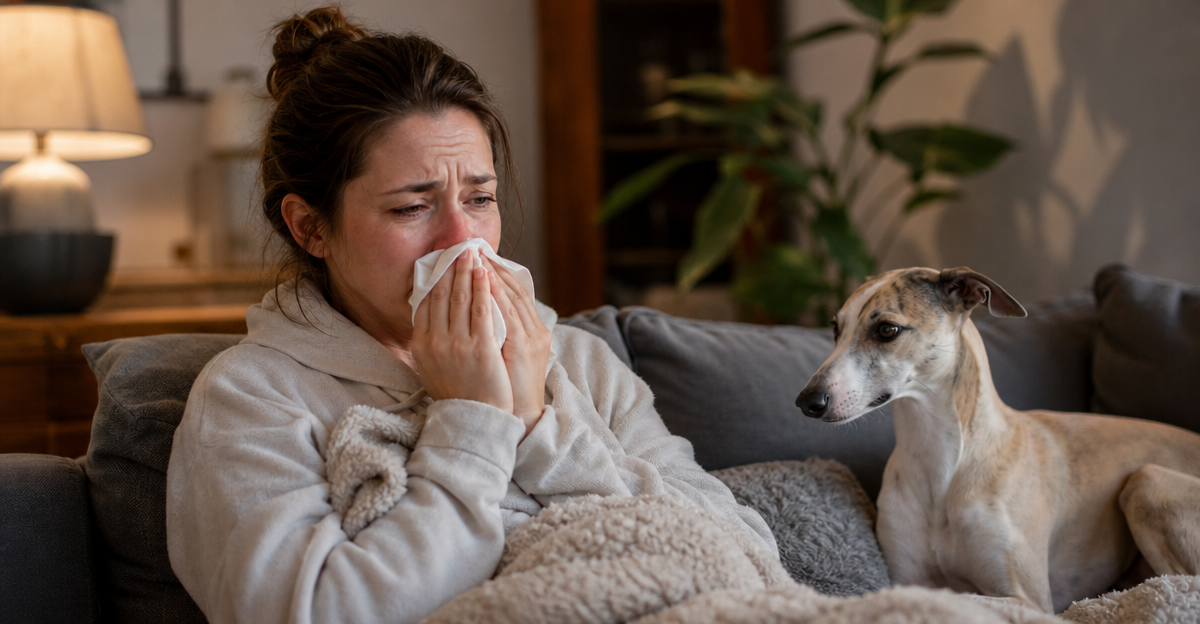
Pet allergy symptoms can range from a persistently runny nose to full asthma attacks, and the culprit is rarely what people expect. It's not your dog's coat or your cat's fur that causes the reaction, but proteins found in their dander, saliva, urine and skin. Understanding this distinction changes how you approach both diagnosis and management.
Key Takeaways
- Pet allergies are triggered by proteins in dander, saliva, urine and skin, not fur itself.
- Symptoms range from sneezing and itchy eyes through to worsening asthma.
- Reactions can appear within 30 minutes in severe cases, or hours to days later in milder ones.
- Diagnosis requires clinical testing. Symptoms alone overlap heavily with colds and hay fever.
- You can develop a new allergy to a pet you have lived with for years without any previous reaction.
- Environmental steps such as HEPA filters and regular cleaning reduce exposure but cannot eliminate allergens entirely.
What Causes Pet Allergy Symptoms?
Your immune system is designed to fight genuine threats. In people with pet allergies, it misidentifies harmless animal proteins as dangerous invaders, producing IgE antibodies in response. Each subsequent exposure triggers those antibodies to signal the release of histamine, which causes the itching, swelling and congestion that most people associate with an allergic reaction.
The proteins responsible come from dander (flakes of dead skin), saliva, urine and sebaceous gland secretions. Fur is not an allergen in its own right. It is, however, an efficient carrier of dander and dried saliva, which is partly why the misconception persists. When a cat grooms itself or a dog shakes after a swim, they are dispersing allergenic proteins into the air around them.
Dogs and cats are the most frequent culprits simply because they are the most common household pets and tend to share close living space with their owners. But they are far from the only animals involved. Rabbits, guinea pigs, hamsters, ferrets, birds and horses all produce allergenic proteins that can trigger reactions in sensitised individuals.
Cross-reactivity is also worth understanding, particularly in multi-pet households. A 2018 consensus document on pet allergy by Dávila and colleagues, published in the journal Allergy, noted that having an allergy to one animal species significantly raises the likelihood of developing sensitivity to others. If you are already reacting to a cat, adding a rabbit to the household is not a straightforward workaround.
The Main Symptoms of a Pet Allergy
Respiratory symptoms
The most common presentation involves the airways. Sneezing, a runny or blocked nose, an itchy or scratchy throat, and watery or itchy eyes are all typical. For people with pre-existing asthma, exposure to pet allergens can trigger wheezing, coughing and shortness of breath, sometimes severely.
Skin symptoms
Direct contact with an animal can cause localised reactions: raised hives, redness, itching or a rash where the skin has touched the pet. These contact reactions are most common on the hands, face and arms, but can appear anywhere.
Less obvious symptoms
Chronic nasal inflammation is tiring. When your immune system is working overtime night and day, and nasal congestion is disrupting your sleep, a persistent low-level fatigue often follows. This is one reason people with undiagnosed pet allergies sometimes spend months assuming they are just run-down or fighting a recurring cold.
How quickly do symptoms appear?
This varies considerably and is one of the most important things to understand about pet allergies. A strong reaction in a highly sensitised person can appear within 30 minutes of exposure. But in milder cases, symptoms can take several hours or even a couple of days to develop noticeably.
That delayed onset is the reason so many people never make the connection to their pet at all. You stroke the cat on Tuesday evening, feel broadly fine, then wake up on Thursday with a streaming nose and assume you have caught something. The link is easy to miss, especially if you have lived with the animal for years without any previous issues.
How Pet Allergy Symptoms Differ From a Cold or Hay Fever
The overlap between these three conditions causes a great deal of confusion. People routinely self-medicate for a cold for weeks, only to eventually realise their symptoms improve when they visit a friend who has no pets, or worsen whenever they sit on the sofa next to the dog.
| Feature | Pet allergy | Common cold | Hay fever |
|---|---|---|---|
| Onset | Minutes to days after exposure | 1 to 3 days after infection | Rapid during pollen season |
| Duration | Persists while exposure continues | 7 to 10 days typically | Seasonal (weeks to months) |
| Fever | No | Sometimes | No |
| Itchy eyes | Very common | Rare | Very common |
| Itchy skin or hives | Possible, especially after contact | No | Occasionally |
| Body aches | No | Common | No |
| Symptom pattern | Worse near pet or after handling | Consistent regardless of environment | Worse outdoors, better indoors |
| Thick, coloured mucus | Uncommon | Common after a few days | Uncommon |
The most useful diagnostic clue you can gather at home is pattern. Do your symptoms improve when you spend a weekend away, then return when you get back? Do they flare up specifically in the room where your pet sleeps? These patterns are worth noting before a GP appointment. They help clinicians piece the picture together more quickly.
Dog Allergy Symptoms vs Cat Allergy Symptoms
The nature of dog and cat allergens is quite different, even though the symptoms they produce are broadly similar.
The primary cat allergen, a protein called Fel d 1, is unusually small, sticky and highly airborne. It clings to walls, soft furnishings, clothing and even surfaces in rooms the cat has never entered. This is why people with cat allergies sometimes react in homes where no cat currently lives, if one was previously present. It also explains why reactions to cats can be particularly difficult to escape.
Dog allergens are more complex. As Chan and Leung noted in a 2018 review, dogs produce a greater number of distinct allergenic proteins than cats, which makes diagnosis more involved and means people can react to some dog allergens without reacting to others. Two people who are both clinically allergic to dogs may have quite different immunological profiles. If dogs are your main concern, our guide to managing dog allergies goes into the specific triggers and treatments in more detail.
You can also react differently to cats and dogs even if you are sensitised to both. One person might develop hives when a dog licks their hand but only sneeze around cats. Individual responses vary, and this is another reason self-diagnosis is unreliable.
Cat allergies are widely reported to be roughly twice as common as dog allergies, though it is worth noting this comparison is frequently cited without a consistently attributed primary source, so treat the specific ratio as an approximation rather than a precise figure.
Symptoms That Can Develop or Change Over Time
One of the most distressing experiences for a pet owner is the arrival of allergy symptoms after years of living comfortably with an animal. You have had the dog for two years. Nothing. Then suddenly your eyes won't stop watering and your chest feels tight every morning. How is that possible?
Allergy sensitisation can develop gradually. Repeated exposure to an allergen over time can eventually tip a person's immune system into treating that protein as a threat, even if it never did before. Early symptoms are often subtle, perhaps a slightly itchier nose in the evenings or occasional eye irritation, and easy to attribute to something else. By the time the pattern becomes obvious, significant sensitisation may already have occurred.
Children who have one or both parents with allergic conditions are at higher risk of developing allergies themselves, though not necessarily to the same triggers. Symptoms appearing without any apparent change in circumstance should not be dismissed, and a GP is the right first port of call.
When Should You See a Doctor?
See your GP if symptoms are affecting your sleep, your concentration or your daily activities. Seek help promptly if you have asthma and notice it worsening. You should also get a clinical opinion whenever you are genuinely unsure whether you are dealing with an allergy, a recurring cold, or something else. Guessing can lead to months of ineffective self-treatment.
A clinical assessment typically involves taking a thorough medical history, often followed by a skin prick test (where small amounts of allergen extract are applied to the skin to observe a reaction) or a specific IgE blood test. Both methods help identify which allergens your immune system is responding to. Diagnosis should always be confirmed clinically. Symptoms alone are too similar across too many conditions to be reliable on their own.
If your GP suspects a complex allergy picture, or if initial management isn't working, ask about a referral to an allergist. Specialist assessment becomes particularly important before considering immunotherapy, or if you are managing multiple allergies simultaneously.
Managing Pet Allergy Symptoms at Home
Environmental control will not eliminate allergens from your home, but it can meaningfully reduce the burden on your immune system. Done consistently, these steps make a real difference to daily symptom severity.

- HEPA air purifiers: High-efficiency particulate air filters capture airborne pet allergens and are one of the most evidence-backed environmental interventions available. Place them in the rooms where you and your pet spend the most time.
- Vacuuming twice weekly: Use a vacuum fitted with a microfilter or HEPA bag. Standard vacuum bags can release fine particles back into the air.
- Wash hands after contact: Avoid touching your face after handling your pet, particularly eyes and nose.
- Create pet-free zones: The bedroom is the priority. Keeping your pet out of the room where you sleep for seven or eight hours a night can substantially reduce overnight allergen exposure.
- Bathe and brush your pet regularly: This reduces the amount of dander and dried saliva on their coat. Do it outdoors if possible, and ideally have a non-allergic household member handle it.
- Wash pet bedding frequently: At least weekly, on a hot wash cycle.
- Hard floors where possible: Carpets trap and hold allergens far more effectively than hard flooring. If full replacement isn't feasible, focus on reducing soft furnishings in rooms your pet uses most.
If you are managing a flare-up or expecting allergic guests at home, boarding your pet temporarily can provide meaningful relief. With over 2,700 pet boarding hotels listed across the UK on Tailstays, finding a suitable place at short notice is more straightforward than many owners realise. Removing the animal from the home reduces active allergen production immediately, though residual allergens in soft furnishings will take longer to clear.
Medical Treatment Options
Treatment should always be guided by your GP or allergist. The options below are a general overview, not a substitute for clinical advice.
Antihistamines are usually the first line of management. Oral antihistamines can help with sneezing, itching and runny nose; nasal antihistamine sprays act more locally and can work faster. Some oral antihistamines cause drowsiness, so the timing and formulation matter.
Nasal corticosteroid sprays are highly effective for persistent nasal symptoms but require patience. They typically take two weeks or more to reach full effect, so they are not useful on-demand in the way antihistamines are.
Allergy immunotherapy (sometimes called desensitisation or allergy shots) involves gradually exposing the immune system to increasing doses of the allergen to reduce its sensitivity over time. It is not a cure, and the process takes months to years, but it can significantly reduce both symptom severity and reliance on medication for suitable candidates. Sublingual (under-the-tongue) immunotherapy is also available for some allergens. Your allergist can advise on whether you are a candidate.
What About 'Hypoallergenic' Pets?
No cat or dog breed is truly hypoallergenic. This is not a matter of debate among allergists. A 2024 review by Hilger and colleagues, published in Allergologia et Immunopathologia (Allergol Select), confirmed that all cats and dogs produce the proteins responsible for allergic reactions, regardless of breed or coat type.
Lower-shedding breeds such as poodles or certain terriers may deposit slightly less dander on surfaces, and some individual animals produce lower amounts of specific allergens than others. But the difference is not zero, and it is not predictable enough to reliably recommend a breed to someone with a diagnosed allergy. If you are seriously considering getting a pet and have a known allergy, speak to an allergist first rather than selecting a breed on allergy grounds alone.
If you or someone in your household has a severe animal allergy and would still like a pet, fish, reptiles and amphibians produce no fur or feathers and are generally far less allergenic. They are not entirely allergen-free (some people react to fish food or tank water) but they represent a genuinely lower-risk option. Smaller caged animals still carry a risk, so if you are weighing up options, our hamster care guide is worth a read before assuming a small pet is a safe compromise.
Pet Allergies and Staying Away From Home
Animal allergens are remarkably persistent. Fel d 1, the primary cat allergen, has been detected in significant concentrations in homes, schools and even aircraft that have no cats present, as research into allergen persistence has shown, carried there on people's clothing. In soft furnishings such as carpets, sofas and mattresses, pet allergens can remain at levels sufficient to trigger symptoms for months after an animal has left the property.
This matters practically if you are visiting friends or family with pets, attending events where animals are present, or staying in any accommodation that previously housed an animal. Taking an antihistamine beforehand and washing clothes and showering after exposure can help reduce the duration of symptoms.
For households where someone has a pet allergy, keeping the family pet out of the home during a flare-up or when hosting allergic guests is a practical option. Boarding removes the source of active allergen production from the environment. Tailstays lists pet boarding hotels across the UK, including options in most major cities, so you can find somewhere suitable without a lengthy search. If it is your first time arranging this, our guide to first-time boarding for nervous owners walks through what to expect.
Frequently Asked Questions
Can pet allergy symptoms appear suddenly after years of no reaction?
Yes, and it is more common than many people realise. Allergy sensitisation is not always immediate. Repeated exposure to an allergen over months or years can gradually prime the immune system to begin reacting, even if there was never any previous response. Early symptoms are often subtle enough to go unnoticed or be attributed to something else, making the eventual escalation seem sudden when it has actually been developing for some time. If you have had a pet for years and are now experiencing new symptoms, take them seriously and seek a clinical assessment.
Can you keep a pet if you're allergic?
It depends on the severity of your allergy. Many people with mild to moderate pet allergies manage successfully with a combination of environmental controls (HEPA filters, pet-free bedroom zones, regular cleaning) and medication. For others, particularly those with asthma that worsens significantly, continued cohabitation may not be safe or sustainable. Rehoming a pet is a genuinely difficult decision, and one no one takes lightly. An allergist can help you understand your specific sensitisation level and what management is realistically achievable before you reach that point.
Do pet allergens stay in a home after the animal is removed?
Yes, for a significant period. Studies have shown that cat allergen in particular can remain detectable in carpets, sofas and mattresses for six months or more after a cat has left the property. Dog allergens also persist, though typically for a shorter duration. Thorough cleaning, including steam cleaning upholstery and replacing or deep-cleaning carpets, speeds up the process, but there is no instant solution. This is worth bearing in mind if you are moving into a property that previously housed pets.
Is it possible to be allergic to one dog but not another?
Yes. Individual dogs produce varying amounts of the proteins that trigger allergic reactions, and the specific proteins involved can differ between breeds and even between individual animals of the same breed. Someone who reacts strongly to one dog may have a milder response to another, depending on what that specific animal produces and in what quantities. This variability is part of why clinical testing is more reliable than spending time with a specific animal as a way of assessing your allergy.
How long do symptoms last after leaving a pet environment?
For most people, symptoms begin to ease within a few hours of leaving the exposure environment. In more severe cases, or after prolonged exposure, symptoms can persist for a day or two. Showering and changing clothes after visiting a home with pets can speed up recovery by removing allergens you have carried with you. If symptoms consistently last several days after leaving a pet environment, that is worth discussing with your GP as it may indicate a higher level of sensitisation.
Can children grow out of pet allergies?
It is possible, but not guaranteed. Some children do see allergy symptoms reduce or resolve as they get older, while others carry sensitivities into adulthood or develop new ones. There is no reliable way to predict which will happen for a given child. A paediatric allergist or your child's GP is the right person to advise on monitoring and management, particularly if the allergy is affecting the child's sleep, breathing or daily activities.