
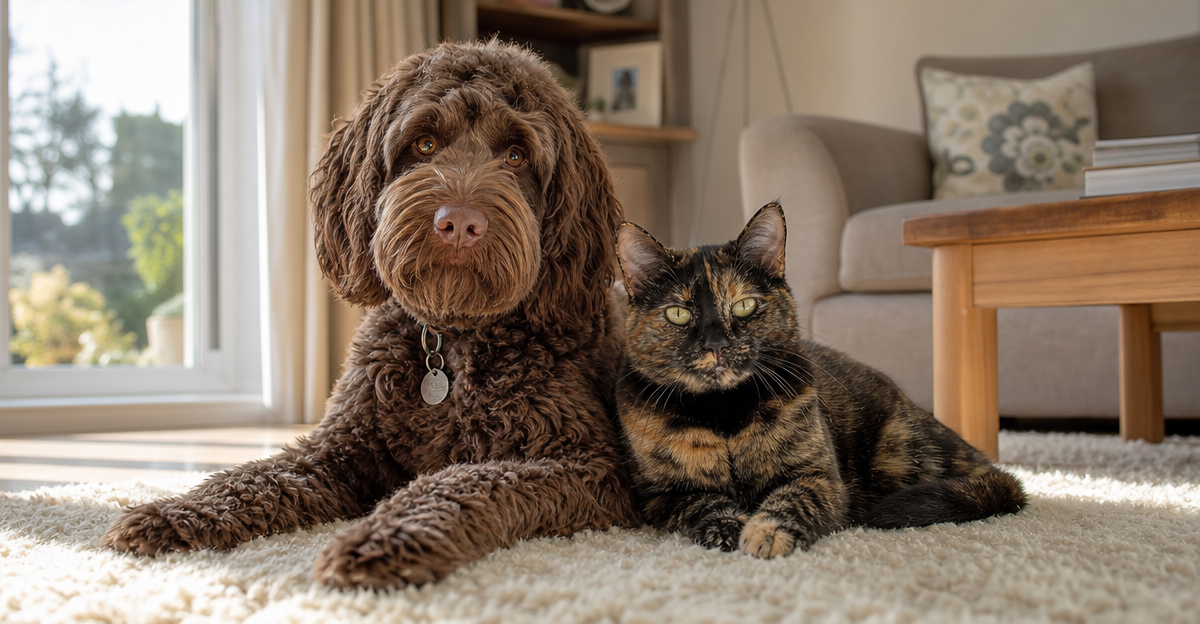
Which Dogs Are Good with Cats?
The honest answer is that any dog can potentially live with a cat, and almost any dog can make it difficult. Breed tendencies give you a useful starting point, but the individual animal's temperament, history, and how carefully you manage the introduction matter just as much. This guide covers both sides of that equation.
Key Takeaways
- Prey drive, energy level, and trainability are the three traits that most predict whether a dog will cope well with cats.
- Breed tendencies are a useful guide, but individual temperament and introduction quality matter more than breed labels alone.
- Your cat's personality is just as important as the dog's breed. A confident cat can handle far more than an anxious one.
- Age and socialisation history of both animals significantly affect how introductions go.
- Even the most cat-friendly breeds need supervised, gradual introductions. No breed is a guaranteed safe bet.
- If either animal shows signs of chronic stress, or the dog cannot disengage from fixating on the cat, professional help from a qualified behaviourist is the right call.
Why Some Dogs Struggle with Cats (and Others Don't)
It's not about aggression. A dog that chases a cat is not necessarily being aggressive. It may simply be following deeply wired instincts that have nothing to do with hostility. Understanding those instincts is the first step to predicting how any particular dog will behave.
The Role of Prey Drive
Prey drive is the instinct to pursue fast-moving animals. It's triggered by movement, which is why a dog can sit calmly beside a resting cat and then bolt the moment that same cat sprints across the room. The two behaviours come from different parts of the dog's brain, and one does not predict the other.
This is an important point that often gets muddled: prey drive is not the same as aggression. A dog chasing a cat is not trying to attack it in the way a dog might guard a resource or react to a perceived threat. That distinction matters because the training strategies, the risk profile, and the management approach are all different. High prey drive dogs (many sighthounds, most terrier breeds, some hound breeds) are not necessarily dangerous or unpredictable in other ways. They just set a higher bar for safe multi-pet living.
Play chasing is a separate issue. A boisterous young dog may chase a cat purely for the fun of the reaction, with no predatory intent at all. Both types of chasing are problematic for a cat's wellbeing, but for different reasons and with different solutions.
Energy Level and Boisterousness
Size is less relevant than many people assume. A calm Great Dane pottering around the house may be a far safer companion for a cat than a wired Jack Russell who treats every room like an obstacle course. What cats struggle with most is relentless, unpredictable energy directed at them.
Even without physical contact, a dog that repeatedly bounds at a cat, invades its resting space, or follows it around the house creates chronic stress. Cats under sustained stress show it in subtle ways: hiding, changes in eating or toileting, over-grooming. It's easy to mistake a stressed cat for a simply 'shy' one. More on that in the red flags section below.
Trainability and Impulse Control
This is the factor that most breed lists quietly ignore. A dog that reliably responds to a 'leave it' cue, that can hold a stay while a cat walks past, and that has learned to settle calmly in a shared space is worth far more than a breed's reputation alone. Trainability is a genuine safety feature in a multi-pet home.
Herding breeds are an interesting case here. Shetland Sheepdogs and Border Collies, for example, often have low prey drive in the conventional sense. They're not trying to catch the cat. But they may try to corral it, nudging, staring, and circling in a way that is deeply stressful for the cat even though no aggression is intended. That herding instinct responds well to training and redirection, which is why trainability matters so much alongside raw breed tendency.
Dog Breed Groups: What the Instinct History Tells You
Breed groups reflect what dogs were historically selected to do. That history shapes instinct in ways that still show up reliably today, even in dogs several generations removed from any working role. The key word is tendencies. Individual variation is always real, and the following should be read as a starting point, not a verdict. If you want a shorter, breed-first overview, our guide to the best dog breeds that get along with cats covers the top picks in one place.
Sporting Group: Generally Good Bets
Sporting breeds were developed to work closely alongside humans, often alongside other dogs and in unpredictable environments. That background tends to produce sociable, adaptable temperaments with moderate to good impulse control.
- Golden Retriever: Friendly and highly trainable, but can be overwhelming for a cat during puppyhood purely through enthusiasm. Needs clear training around the cat from the start. The temperament is right, but the exuberance needs managing.
- Labrador Retriever: Easygoing, non-territorial, and generally good at reading social cues. A well-trained Labrador is one of the more reliable choices for a home with cats.
- Cocker Spaniel: Gentle and adaptable, the Cocker Spaniel is often overlooked on breed lists in favour of more obvious choices. It tends to be a low-drama companion for cats and suits a variety of living situations.
- Irish Setter: Energetic and a little clumsy in early life, but trainable and genuinely sociable long-term. Suits households with a confident cat and an owner willing to invest in training during adolescence.
Toy Group: Small Size, Often Big Compatibility
Toy breeds were developed for companionship, not hunting or herding. As a group, they tend toward lower prey drive and less physical intimidation, both relevant factors for cat compatibility. That said, 'small' does not automatically mean 'calm'.
- Cavalier King Charles Spaniel: One of the most consistently cat-friendly breeds, and one that rarely appears on competitor breed lists despite being among the most popular dogs in the UK. Cavaliers are gentle, sociable, and low in prey drive, and they tend to take their social cues from the people and animals around them. A strong choice for a multi-pet household.
- Maltese: Quiet, gentle, and undemanding. The Maltese tends to coexist with cats with minimal drama, making it a genuinely low-stress option.
- Pug: Calm and sociable with a low chase instinct. Worth noting honestly that Pugs are a brachycephalic breed. Their flat faces can cause respiratory issues, so they should not be in situations that encourage overexertion or sustained excitement.
- Bichon Frise: Friendly but exuberant. Best suited to a household with a confident, unbothered cat rather than a timid or anxious one.
- Papillon: Sociable and quick to learn, but can become overexcited in play. Suits cats that are self-possessed enough to disengage and walk away.
Hound Group: Proceed with More Care
The hound group is not a monolith, and the distinction between scent hounds and sighthounds matters enormously here, a nuance that most breed guides miss entirely.
Sighthounds (Greyhounds, Whippets, Salukis, Borzois) were bred to spot and chase prey at speed. Their prey drive is among the highest of any breed group, and a running cat can trigger a chase response almost reflexively. That said, the picture is more nuanced than a simple 'avoid' verdict. Many retired Greyhounds are carefully assessed for cat compatibility before rehoming, and a sighthound that has been cat-tested and lived successfully with cats can coexist well. The key is knowing the individual dog's history. Going in blind with a sighthound and a cat is high-risk; going in with a cat-tested, experienced dog is a different situation entirely.
Scent hounds are a different proposition. They were bred to follow a trail with their nose, not to visually chase prey at speed. Their chase instinct toward cats is generally more manageable.
- Basset Hound: Low energy and laidback. Bassets were bred specifically for scent trailing, which is worth knowing in context, but their unhurried pace and calm disposition mean that prey drive is usually present in a very muted form. Stubborn to train, which matters for impulse control work.
- Beagle: Pack-oriented and generally sociable, which can work in a multi-pet home. The behavioural logic that two Beagles together might be more likely to form a dynamic that unsettles a cat (pack mentality amplifying chase behaviour) has some basis in how pack breeds operate, but treat this as a sensible caution rather than a certainty, and always introduce any combination gradually.
Working and Herding Groups: Case by Case
These breeds vary enormously in temperament and instinct, and the working group especially contains some of the most trainable dogs available. That trainability is an asset in a multi-pet home, but it does not cancel out the need for careful socialisation.
- German Shepherd: Highly trainable and loyal, but requires thorough socialisation from an early age. Not the easiest starting point for a home with a nervous or inexperienced cat. In the right hands, with the right cat, they can coexist well.
- Shetland Sheepdog: Mild and responsive, but may attempt to herd the cat, not out of aggression but out of instinct. This is very manageable with training and tends to diminish when the dog learns it doesn't work.
- Bernese Mountain Dog: Calm, gentle, and generally good-natured in multi-pet environments. Often overlooked in favour of more fashionable breeds.
- Newfoundland: Famously patient and gentle. Their size can be alarming to a cat initially, but their actual temperament makes them one of the more reliable gentle giants for a mixed household.
Terrier Group: Usually the Hardest Fit
Terriers were bred specifically to find, chase, and in many cases dispatch small animals. That instinct runs deep and breeds true across generations. This is not a reason to automatically rule out every terrier, but it is a reason to be honest rather than optimistic.
Most terriers, Jack Russells, Airedales, Bedlingtons, Fox Terriers, require experienced owners, consistent and skilled management, and ideally a cat that is robust and confident enough to hold its own. They are not the right starting point for someone new to multi-pet households.
The Boston Terrier is a genuine exception worth noting. Despite the name, Bostons sit in the Non-Sporting group in the US and were bred as companion dogs rather than working terriers. Any chasing tendency tends to be play-motivated rather than prey-motivated, and their temperament is broadly sociable. They represent a meaningfully different risk profile from other terrier-type breeds.
Don't Forget Your Cat's Personality
Almost every guide on this subject writes as though the dog is the only variable. The cat's personality, history, and age are equally important, and in some cases they're the deciding factor.
A confident, bold cat that has lived with dogs before will adapt far more quickly than a timid, anxious cat encountering a dog for the first time. That timid cat will feel threatened by almost any dog, regardless of breed, and will show it through hiding, reduced appetite, and stress behaviours that are easy to miss until they become serious. The boldest Labrador in the world will still stress a cat that is fundamentally fearful of the situation. If your cat already shows signs of anxiety, our guide to common cat behaviour problems is a useful companion read.
Senior cats and very young kittens are at higher risk. Older cats may find the adjustment exhausting, and kittens are physically vulnerable to even well-intentioned rough play. Both groups need particularly careful management and more conservative introduction timelines.
Some cat breeds tend to cope better with dogs than others. Maine Coons, Ragdolls, and American Shorthairs are often cited as starting points, and the behavioural reasoning behind these suggestions is worth understanding, not just the labels. Maine Coons and Ragdolls tend toward confident, laid-back temperaments and are less likely to respond to a dog's presence with the kind of panicked fleeing that triggers a chase. British Shorthairs similarly tend to be self-possessed and unflappable. These traits matter more than breed name, so if you're getting a cat to join a home with a dog, looking for an individual animal with a calm, confident character is more useful than fixating on breed alone.
Cats that have been raised around dogs, or that have lived in busy households, typically adjust more quickly than those coming from quieter, single-animal homes. If you know the cat's history, factor it in.
How to Introduce a Dog to a Cat
Breed choice gets all the attention, but the introduction process is where outcomes are actually determined. A well-suited breed introduced badly will struggle; a more challenging breed introduced carefully and patiently often does far better than expected. Most guides list breeds and say almost nothing about this part. Here is the process in practical terms.
Prepare the Home Before the Dog Arrives
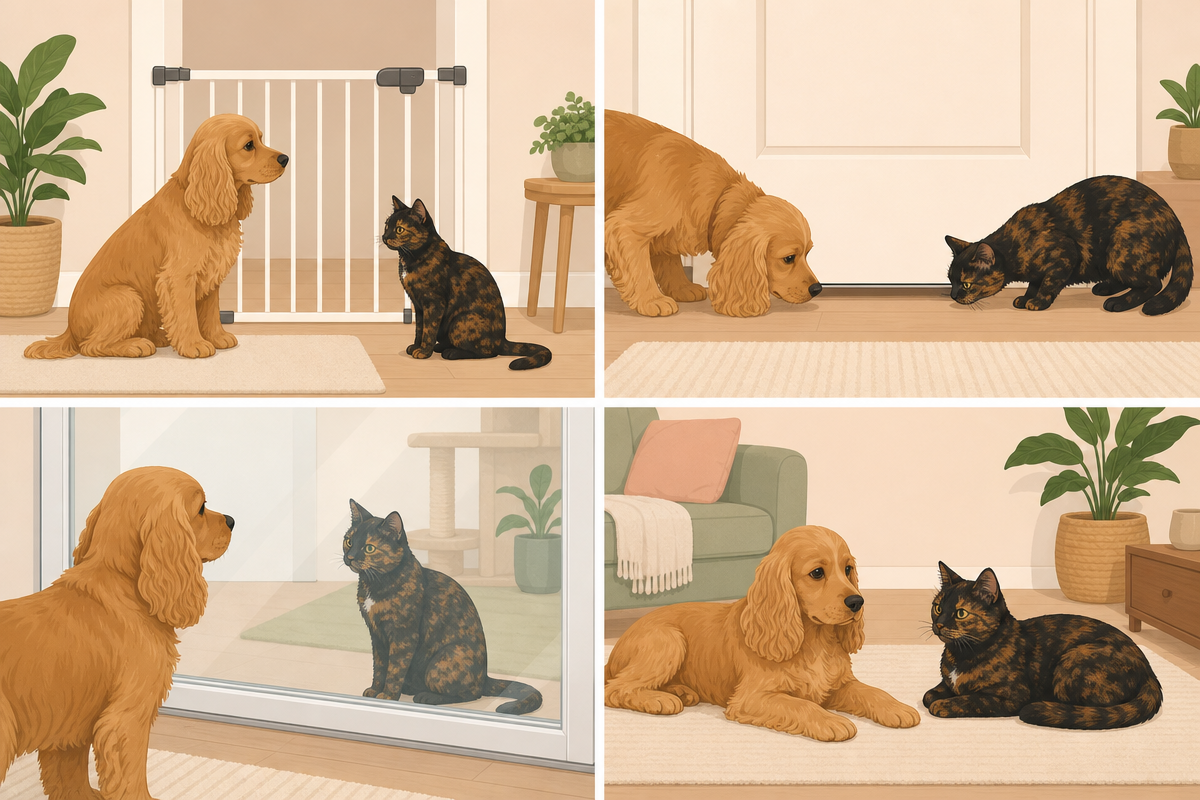
Before the dog ever meets the cat, make sure the cat has options. Cat-only zones that the dog cannot physically access, behind a baby gate, up high on shelves or a cat tree, in a room with a cat flap, give your cat somewhere to go when it wants to opt out. This is not just comfort; it's essential for preventing the kind of cornered defensive behaviour (scratching, hissing, panic) that sets introductions back significantly.
Set up feeding stations well apart from each other. The cat's food, water, and litter tray should all be in locations the dog cannot reach. A cat that cannot access its litter tray without passing the dog will start avoiding it, which is both a welfare problem and an early warning sign that the arrangement isn't working.
Introduce Scent Before Any Face-to-Face Meeting
Swap bedding between the dog and cat so each can investigate the other's scent in a calm, unthreatening context. This is not a trivial step. For animals that rely heavily on scent to read their environment, arriving at a first visual encounter already knowing the other animal's smell significantly reduces the intensity of the reaction.
Feed both animals on opposite sides of a closed door between them. The goal is to build a positive association with the other animal's scent before any visual contact happens. Do this over several days before moving to the next stage.
Manage the First Visual Contact Carefully
The dog should be on a lead. The cat should be free to move and, critically, free to leave. Keep the first sessions very short: two to three minutes is enough. You are not trying to achieve anything dramatic at this stage; you are simply letting both animals establish that the other exists without anything frightening happening.
Watch the dog carefully. The warning signs to look for go beyond obvious barking: a dog that freezes and stares with an unblinking, fixed gaze, a dog that whines with intensity while straining toward the cat, or a dog that cannot be distracted from the cat even briefly. These are signs to slow down and seek guidance. Watch the cat too. Ears flattened, body low and frozen, or attempts to flee are signals to end the session and give more time before the next one. Never push through obvious distress on either side.
Build Up to Shared Space with Supervision
As both animals become calmer in each other's presence, you can begin allowing shared space, always with full supervision, always with the dog's behaviour under your control. Reward the dog generously for calm behaviour around the cat: lying down, looking away, ignoring the cat. Treat-based reinforcement works better than verbal praise alone here, because you're trying to shift the dog's emotional association with the cat toward something positive and low-key.
Allow the cat to set the pace entirely. If the cat chooses to approach the dog, that's a positive sign. If it prefers to observe from a distance, that's fine too. Forcing interaction, placing them close together, blocking the cat's exit, reliably makes things worse and often sets progress back by days or weeks.
Do not leave them alone together until you are genuinely confident in the dog's behaviour, not just optimistic about it. That threshold is different for every pair.
When to Seek Professional Help
This step is missing from almost every guide on this topic, and it matters. If, after several weeks of careful, patient introduction, the dog cannot disengage from fixating on the cat, if no amount of training, management, or time seems to shift the dynamic, that is not a failure of effort. It is a signal that you need specialist input.
The right professional here is a certified clinical animal behaviourist (CCAB) or a behaviourist registered with the Association of Pet Behaviour Counsellors (APBC). These are not the same as a general obedience trainer. Multi-species household dynamics, predatory behaviour, and chronic stress in cats are specialist areas. A well-meaning but unqualified trainer can give advice that makes things worse, particularly around high prey drive situations. Ask specifically about experience with dog-cat introductions before booking any professional.
Signs that the cat may need its own assessment: permanent hiding, significant changes in eating or litter tray use, over-grooming, or visible weight loss. These are signs of chronic stress, not just initial adjustment. A vet behaviourist or feline specialist can help assess the cat's welfare and advise on next steps.
Red Flags to Watch For, Even with Cat-Friendly Breeds
A breed reputation is not a guarantee, and even well-regarded breeds can present warning signs that need taking seriously. Watch for these at any stage of cohabitation, not just during initial introductions.
- Predatory fixation: An intense, unblinking stare at the cat that the dog holds even when you try to distract it. This is different from casual curiosity, and the distinction matters.
- Cannot be redirected: A dog that ignores even high-value food when the cat is present is showing a level of fixation that warrants professional input.
- Cat stops using key areas of the home: If the cat has stopped using its litter tray, is eating less, or has retreated permanently to one room, the dog's presence is causing chronic stress regardless of whether any contact is occurring.
- Resource guarding toward the cat: A dog that growls when the cat approaches its bed, bowl, or favourite spots is showing a different but serious problem that needs addressing.
- Physical contact that frightens the cat: Even if the dog is 'just playing', any contact that causes the cat to flee, hiss, or cower should be treated as a problem. The cat's experience is what matters here, not the dog's intent.
Multi-Pet Households and Pet Boarding
If you have both a dog and a cat and you're planning a trip, boarding logistics are worth thinking through in advance. Many pet hotels cater to dogs or cats, but not always both under the same roof, and some that do accept both species keep them in separate areas.
If your dog and cat have a settled, comfortable relationship at home, it's worth asking any boarding provider whether adjacent or shared spaces are possible. For some pairs, being near each other reduces separation anxiety rather than adding to it. For others, the unfamiliar environment of a boarding facility makes it better to keep them in completely separate arrangements. If separation anxiety is already a concern for your dog, our guide on separation anxiety and dog boarding goes into more detail.
When enquiring about dog boarding specifically, tell the provider that your dog lives with a cat. This is useful information for how they manage kennel neighbours and communal spaces. A dog that is well-habituated to cats is a different boarder from one that isn't, and good providers will factor that in. For cats, it's worth reading up on why cats get stressed at the cattery so you can spot the difference between normal settling in and genuine distress.
Tailstays lists pet hotels across the UK, including pet hotels in London, Leeds, Bristol, and many other locations. You can search by area to find providers that accept both dogs and cats, and compare what each offers before reaching out directly.
Frequently Asked Questions
Are there any dog breeds that should never live with cats?
No outright bans, but breeds with very high prey drive, including most sighthounds, the majority of terrier breeds, and some working dogs like Alaskan Malamutes, require experienced owners, careful long-term management, and ideally professional guidance. They can coexist with cats in the right circumstances, but they are not the right starting point for someone new to multi-pet households.
Is it easier to introduce a puppy to a cat or an adult dog?
Puppies are generally easier to socialise because their habits and associations are not yet fixed. But they are also chaotic, relentlessly energetic, and exhausting for cats to live with during adolescence. A calm, well-trained adult dog with a known history of living peacefully with cats can actually be an easier and less stressful introduction for an established cat.
My dog ignores my cat at home. Does that mean they're fine together?
Usually a good sign, but worth staying alert to one important caveat: a dog that is perfectly calm around a resting cat may still chase a running one. Movement triggers a different instinct, and a dog that has never shown any interest in the cat could still react very differently if the cat suddenly bolts. Monitor what happens when the cat runs or jumps down from height.
Can a cat hurt a dog?
Yes. A cat scratch to the eye is a genuine risk, particularly for smaller dogs or puppies. Ensuring the cat always has a clear escape route is important not just for the cat's welfare but to prevent defensive scratching or biting from a cat that feels cornered. A cat that can leave will rarely need to lash out.
How long does it take for a dog and cat to get used to each other?
Most pairs reach stable, relaxed cohabitation within a few weeks to three months with careful introductions. Some take longer, particularly if either animal is older or has a history of stressful experiences with the other species. Forcing the pace almost always sets progress back. Patience, structure, and letting the cat lead the relationship are consistently more effective than rushing toward unsupervised time together.